
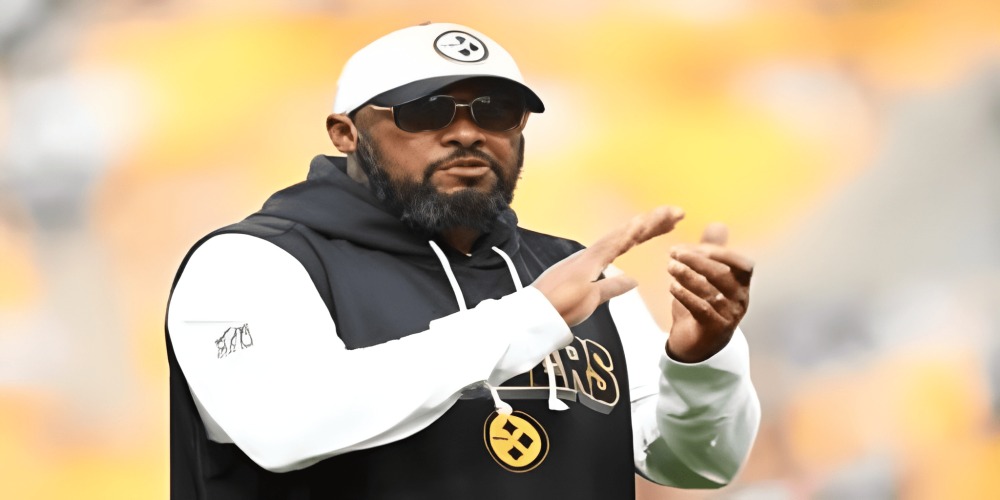
In the high-stakes, results-driven ecosystem of the National Football League, stability is often a myth. Teams cycle through head coaches like quarterbacks, searching for the alchemy of leadership that turns talent into trophies. Yet, for nearly two decades, one figure has stood as an immovable object in a sea of chaos: Mike Tomlin.
To understand Mike Tomlin is to look past the surface-level statistics, the furrowed brow on the sidelines, and the Super Bowl ring that glistens from 2008. It is to understand a philosophy rooted in an almost radical rejection of comfort. While other coaches lament the shortcomings of modern players or blame roster deficiencies, Mike Tomlin runs toward the fire.
As of the 2025-2026 season, Mike Tomlin has officially stepped away from the sidelines, ending a historic 19-year tenure with the Pittsburgh Steelers. He leaves behind a legacy that transcends his 193 regular-season wins and his place at number ten on the all-time wins list . He leaves behind a blueprint on how to lead humans.
The Rise of a Different Kind of Leader
The origin story of Mike Tomlin is not one of privileged access or a famous last name. It is a story of relentless, almost obsessive effort. In 2001, a relatively unknown 29-year-old coach at the University of Cincinnati caught the eye of legendary Tampa Bay Buccaneers defensive coordinator Monte Kiffin.
Kiffin, a man who had seen thousands of coaches cycle through his meeting rooms, recalled interviewing over a dozen candidates for a defensive backs coaching position. When he finally brought Mike Tomlin in, he knew immediately that he had found something rare. "I call it the ‘it factor,’" Kiffin later said. "Some guys just have it. You can feel it" .
Mike Tomlin entered a locker room in Tampa that featured future Hall of Famer John Lynch, a player six months older than the coach himself. The dynamic was fraught with potential disaster. How does a man in his twenties command the respect of millionaire veterans? Mike Tomlin answered that question with a simple, effective strategy: he worked harder than everyone else.
Having no resume to rest on, Mike Tomlin relied on value. He pushed himself to provide insights that veteran players hadn't heard before. This ethos—that coaching is a service, not a dictatorship—would become the bedrock of his philosophy. After a brief but impactful stint as the Vikings defensive coordinator in 2006, Mike Tomlin stunned the league by landing the head coaching job for the Pittsburgh Steelers in 2007. He was only 34 years old, taking over a franchise that had known only two coaches since 1969.
The Philosophy: Running Toward the Grind
Perhaps the most revealing insight into the psychology of Mike Tomlin came during a recent appearance on The Pivot podcast. In a league where coaches often complain about the "entitlement" of younger generations or the difficulty of teaching, Mike Tomlin expressed a polar opposite view.
"I love to hear coaches resist the responsibility of coaching," Mike Tomlin stated. "They talk negatively about a dude that can't learn. Man, if everybody could learn, we'd need less coaches. I love reading draft evals and somebody's talking about anything other than pedigree. Talking about how poor somebody's hand usage is. Well, that's coaching. I don't run away from coaching, I run to coaching" .
This quote is the Rosetta Stone for decoding Mike Tomlin. He views deficiencies not as barriers, but as the very reason for his employment. In a culture that often seeks the path of least resistance, Mike Tomlin seeks the hard road. He argues that when a coach dismisses a player as "uncoachable," the coach is merely seeking comfort to mask their own failure to teach.
This relentless pursuit of the "uncomfortable" is what allowed Mike Tomlin to navigate the minefield of the post-Ben Roethlisberger era without burning the house down. He has done an admirable job managing volatile personalities, from Antonio Brown to George Pickens, without ever losing the locker room.
Former Steelers offensive coordinator Todd Haley recalled how Mike Tomlin managed the ego of superstar receiver Antonio Brown. While Haley would grow frustrated with Brown's tardiness or sideline antics, Mike Tomlin would shut the door and say, "Relax, I'll handle it." He taught his staff patience. "Just coach the player," Mike Tomlin would advise .
The Player's Coach: Empathy as a Strategy
The secret power of Mike Tomlin was never his X’s and O’s, though his defensive acumen is Hall of Fame worthy. It was his emotional intelligence. Running back Najee Harris, who played under Tomlin, recently articulated what makes the coach so unique in a business often described as "cutthroat."
"He’s a player’s coach," Harris explained. "He’s gonna come into the locker room. Chop it up with us. Chill with us … talk about stuff besides football, just talk about life stuff. That makes you feel a little more comfort in this business that we’re in that’s so cutthroat. Not too many people, especially in that position as head coach, would show that side" .
Harris emphasized that Mike Tomlin is transparent. "He’s not gonna sugarcoat nothing, he’s gonna be for real and be straight up with you." This duality—the ability to be a "player's coach" while maintaining strict accountability—is the tightrope that Mike Tomlin walked perfectly for 19 years.
He understood that every player is motivated differently. He would study college programs not just for talent, but for social media trends. He would ask college coaches to introduce him to their 21-year-old social media coordinators to understand what the players were looking at . When interviewing prospects at the NFL Combine, Mike Tomlin would often blow his own staff away by asking deeply personal questions about a player’s family or background before they had even reviewed the tape, proving he had done his homework.
This ability to build a unique relationship with every person in the building allowed Mike Tomlin to push them harder than anyone else could.
The Financial and Statistical Giant
The respect for Mike Tomlin is also reflected in his compensation. For years, he was consistently among the highest-paid coaches in North American sports. In 2024, Mike Tomlin signed a three-year extension reportedly worth $50 million, setting his annual salary near the $17 million per year mark . His estimated net worth settled around the $30 to $40 million range, a testament to his longevity and the Steelers' unwavering faith in his leadership .
When you look at the record of Mike Tomlin, the phrase "non-losing seasons" stands out above all else. From his first day on the job in 2007 to his final game in 2025, Mike Tomlin never finished a season with a losing record. He racked up a regular season record of 193-114-2, a winning percentage of .628 that places him in the elite tier of NFL history .
However, the later years of his career invited a specific critique: the playoff drought. After reaching Super Bowl XLV in 2010, Mike Tomlin was unable to return to the big game. From 2017 through his final season, the Steelers struggled to win in January. Critics argue that while Mike Tomlin prevented the floor from caving in, the ceiling lowered. His overall playoff record sits at 8-12 .
Yet, even in the face of first-round exits in his final five post-season appearances, the aura of Mike Tomlin never diminished. The reason is simple: context. He kept a franchise afloat during the decline of a Hall of Fame quarterback, the rebuild of an offensive line, and the transition to a new generation of talent. He never bottomed out. In the NFL, never being bad is sometimes harder than being occasionally great.
The Coaching Tree Controversy
One of the most persistent narratives surrounding Mike Tomlin is the perceived lack of a "coaching tree." In NFL circles, a coach’s legacy is often measured by how many of his assistants go on to become head coaches. By that metric, Mike Tomlin appears lacking compared to peers like Andy Reid or Bill Belichick.
However, a deeper look reveals that this critique is largely overblown. Unlike other head coaches who hire young, hungry coordinators looking to climb, Mike Tomlin often hired established figures. He brought in Todd Haley, Mike Munchak, Brian Flores, and Arthur Smith—men who had already been head coaches or were established veterans.
As analysts have pointed out, if you apply the same rigid standard to legends like Chuck Noll or Bill Cowher, their trees look similarly bare. Mike Tomlin’s legacy is not that he spawned clones of himself around the league, but that he created a stable environment where coaches could rehabilitate their careers. He preferred competence over ego. "He had his own unique relationship with every player and every coach," current OC Arthur Smith noted. "He’s just a very approachable person" .
The Final Chapter
Mike Tomlin steps away from the game not as a coach who was fired, but as a legend who walked on his own terms. His departure marks the end of an era for the Pittsburgh Steelers, a franchise now tasked with finding the fourth head coach since 1969.
As he exits, his words from that basement interview in 2025 echo louder than ever. Mike Tomlin never ran from the hard work of coaching. He ran to it. He saw the diva wide receiver, the aging veteran, and the raw rookie not as problems, but as puzzles to be solved.
In a world of artificial intelligence and analytics, Mike Tomlin remained stubbornly, beautifully human. He proved that leadership is not about systems or schemes; it is about connection, transparency, and the courage to never get comfortable.
Frequently Asked Questions About Mike Tomlin
Q1: Why did Mike Tomlin leave the Pittsburgh Steelers?
After the 2025 season, Mike Tomlin made the decision to step down from his role as head coach. While he had a contract running through 2027, the decision was reportedly mutual and amicable. Mike Tomlin expressed a desire for a break from the grueling NFL schedule, having never taken a season off since 2001. The organization honored his decision, acknowledging that his accomplishments "will likely never be duplicated" . He left the franchise in a stable condition, a rarity for a coach of nearly two decades.
Q2: Has Mike Tomlin ever had a losing season?
No. This is perhaps the most impressive statistical anomaly of his career. Across 19 seasons as the head coach of the Steelers, Mike Tomlin never finished a year with a losing record. Even during "rebuilding" years where the roster lacked depth or the quarterback play was inconsistent, Mike Tomlin always managed to scrape together at least eight wins. He owns the record for the most consecutive non-losing seasons to start a head coaching career .
Q3: How many Super Bowls did Mike Tomlin win?
Mike Tomlin has won one Super Bowl as a head coach. He led the Steelers to victory in Super Bowl XLIII against the Arizona Cardinals in a 27-23 thriller, highlighted by Santonio Holmes's toe-tapping catch in the corner of the end zone. Mike Tomlin also led the Steelers to Super Bowl XLV the following year (2010), but they lost to the Green Bay Packers . He remains one of the youngest head coaches ever to win a Super Bowl.
Q4: What is Mike Tomlin’s coaching philosophy regarding difficult players?
Mike Tomlin is famous for not shying away from "problem" players. Unlike many coaches who draft based purely on character reports, Mike Tomlin looks for talent and trusts his ability to manage the personality. His philosophy is rooted in empathy and directness. He believes that labeling a player as "difficult" is often an excuse for lazy coaching. He famously tells his staff, "Just coach the player," meaning they should focus on extracting the talent rather than judging the person .
Q5: Who is on the Mike Tomlin coaching tree?
The "coaching tree" of Mike Tomlin is a topic of debate. While he has not produced a high volume of current NFL head coaches, several prominent coaches spent significant time under his tutelage. This includes Bruce Arians (who was promoted by Tomlin before leaving to win a Super Bowl with Tampa Bay), Todd Haley, and Mike Munchak. However, Mike Tomlin often hired established coordinators rather than green assistants, which naturally limited the growth of a traditional "tree" .
Q6: How does Mike Tomlin motivate his team?
Mike Tomlin uses a mix of psychological tactics and genuine relationship building. He is known for his "one-liners" and analogies, such as "two dogs, one bone," which he uses to create competition for roster spots. He also utilizes "The Hole," his private office where he studies cutups to give his coordinators specific point totals needed to win on Sunday. His primary tool, however, is transparency. Players respect Mike Tomlin because he tells them the truth to their face .
Leave A Comment
0 Comment