
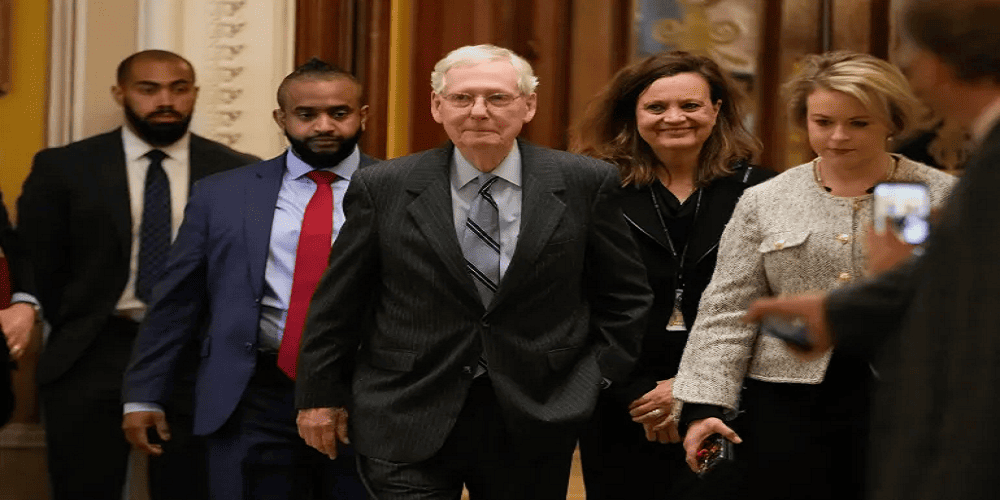
Mitch McConnell is one of the most important political figures in modern U.S. history. Mitch McConnell enjoyed a career in politics that lasted over 40 years, and was known for his determined approach to legislating among other things during his time as Senate's Republican leader, and a divisive figure in the U.S. Senate. From his own triumph over “enemies” ranging from polio to political naysayers, his career will help illustrate how power has shifted in America, and how our country’s institutions have adapted.
For this sweeping portrait, we follow Mitch McConnell from his early years to his ascendancy in Kentucky politics, and to his position as one of the most influential figures in the country—and recent retiree. We delve into his leadership style, influence on policy, controversies and impact on American democracy before ending with a FAQ for those still seeking context about his career and legacy.
Early Life and Formative Years
Mitch McConnell was born Addison Mitchell McConnell Jr. on February 20, 1942, in Tuscumbia, Alabama. His early childhood was marked by significant health challenges, including battling polio at a young age. This experience instilled in Mitch McConnell resilience and determination, traits that would define his later career. After recovering from polio, his family relocated to Louisville, Kentucky, a move that would shape his personal and professional identity. (Encyclopedia Britannica)
McConnell excelled academically and socially, eventually earning a Bachelor of Arts degree from the University of Louisville in 1964 and a law degree from the University of Kentucky College of Law in 1967. During his education, McConnell displayed leadership qualities, serving in student government positions and engaging deeply with campus political life. (Encyclopedia Britannica)
These early experiences — overcoming illness, adapting to new environments, and engaging in leadership roles — formed the foundation of Mitch McConnell’s political ambitions. His legal training prepared him for the complexities of legislative work, while his personal background informed his views on public service and governance.
Entry Into Public Office
Mitch McConnell began his public service career in earnest after working as a legislative assistant to U.S. Senator Marlow Cook from 1968 to 1970. This experience provided McConnell with firsthand knowledge of federal legislative processes and cultivated relationships that would serve him later. (Encyclopedia Britannica)
He then served briefly as a deputy assistant U.S. attorney general under President Gerald Ford and later as chief judge (judge/executive) of Jefferson County, Kentucky from 1978 to 1985. In 1984, McConnell achieved a historic victory by winning a seat in the U.S. Senate — the first Republican statewide victory in Kentucky since 1968. (Encyclopedia Britannica)
This marked the beginning of a long and uninterrupted tenure in the Senate for Mitch McConnell, as he continued to win re-election through multiple terms, consolidating support among Kentucky voters and national Republican circles.
Senate Career: An Overview
Once in the Senate, Mitch McConnell quickly established himself as a savvy legislator with a strategic grasp of procedure and power. Early in his Senate tenure, he gained attention by opposing campaign finance reform measures and aggressively defending free speech arguments in federal election law debates. His political positioning often placed him at odds with Democrats and even some members of his own party. (Encyclopedia Britannica)
McConnell’s rise in Senate leadership began with roles such as majority whip (2003–2007). His skills in managing party strategy and coordinating legislative priorities earned him the position of Senate Republican Conference leader in 2007 — a role he held for an unprecedented period, making him the longest-serving Senate party leader in U.S. history. (Wikipedia)
From 2015 to 2021, McConnell served as Senate majority leader, leading Republican efforts to shape policy priorities and confirm judicial appointments. During these years, Mitch McConnell became especially known for his focus on reshaping the federal judiciary, most notably through Supreme Court confirmations that shifted the court’s ideological balance to the right. (mcconnell.senate.gov)
Judicial Influence and Supreme Court Strategy
One of the defining features of Mitch McConnell’s legacy is his approach to judicial confirmations. In 2016, following the death of Supreme Court Justice Antonin Scalia, McConnell refused to allow President Barack Obama’s nominee, Merrick Garland, to receive a Senate hearing or vote — a decision justified by McConnell as respecting electoral timing but widely viewed as a strategic maneuver. (Wikipedia)
After the election of President Donald Trump, McConnell advanced a change to Senate rules that eliminated the filibuster for Supreme Court nominees, clearing the path for rapid confirmation of conservative justices. The confirmations of Neil Gorsuch, Brett Kavanaugh, and Amy Coney Barrett under McConnell’s leadership reshaped the Supreme Court for generations. (mcconnell.senate.gov)
Supporters of Mitch McConnell argue that these confirmations fortified constitutional originalism and balanced judicial interpretation. Critics contend that the strategies weakened bipartisan norms and heightened polarization in judicial confirmations. Regardless of perspective, McConnell’s influence on the judiciary remains one of his most significant legacies.
Legislative Philosophy and Partisan Strategy
Throughout his Senate career, Mitch McConnell was known for his unwavering commitment to Republican priorities and procedural mastery. He frequently used Senate rules — including the filibuster — to block legislation proposed by Democratic majorities on issues ranging from healthcare reform to climate policy and gun control. (Wikipedia)
McConnell’s supporters credit him with protecting conservative principles and defending institutional norms against what they saw as executive overreach or partisan policymaking. Conversely, his opponents argue that his leadership style entrenched gridlock and prioritized political victory over legislative compromise. McConnell’s tenure illustrates the complexities of party leadership in a deeply divided political era.
Relationship With Presidential Administrations
Mitch McConnell’s Senate leadership spanned multiple presidential administrations, and his relationship with presidents often reflected political realities rather than personal ideology. During the Obama presidency, he led Republican opposition to key Democratic initiatives, including the Affordable Care Act and financial sector reform efforts, using procedural tactics to slow or block bills. (Wikipedia)
Under Donald Trump’s administration, McConnell largely aligned with the president’s agenda, particularly on judicial nominations and tax reform legislation. However, in the aftermath of the 2020 election and the January 6 Capitol attack, McConnell’s stance diverged at critical moments. While he voted to acquit Trump in a Senate impeachment trial, McConnell later condemned the instigators of the attack and held Trump “practically and morally responsible” for provoking it. (Encyclopedia Britannica)
These nuanced relationships reinforced McConnell’s reputation as a leader fiercely committed to institutional integrity, even when it meant challenging figures within his own political coalition.
Health Challenges and Later Career
In recent years, Mitch McConnell faced increased public attention not only for his political actions but also for his health. Reports documented several falls and episodes that raised concerns about his mobility and overall well-being. (mint)
Despite these challenges, McConnell continued to fulfill his Senate responsibilities and leadership duties. However, by 2024, he stepped down from his role as Senate Republican leader, passing the mantle to younger party members. (AP News)
Then, on his 83rd birthday in February 2025, Mitch McConnell announced that he would not seek reelection in 2026, signaling the end of his long Senate career. He described his service as “the honor of a lifetime” and committed to completing his term, which will conclude in January 2027. (People.com)
This decision marked a major shift in the Republican Party’s leadership and opened the door for new figures to shape Kentucky’s political future and national legislative agendas.
Legacy and Impact
The legacy of Mitch McConnell is complex and multifaceted. As the longest-serving Senate party leader in history, he wielded unparalleled influence over legislative strategy, judicial appointments, and the direction of Republican politics. His focus on judicial confirmations, strategic use of Senate procedures, and unrelenting party discipline are major aspects of his historical imprint.
Supporters argue that McConnell protected conservative values and upheld institutional fidelity, while critics assert that his tactics contributed to increased polarization and weakened bipartisan collaboration. Regardless of perspective, the name Mitch McConnell will remain central in discussions of 21st-century American politics.
Frequently Asked Questions (FAQs)
Who is Mitch McConnell?
Mitch McConnell is an American politician who has served as a United States Senator for Kentucky since 1985. He is a member of the Republican Party and has held key leadership roles, including Senate majority leader and minority leader. (Wikipedia)
What notable positions has Mitch McConnell held?
McConnell served as Senate majority leader from 2015 to 2021 and Senate minority leader in other periods, becoming the longest-serving Senate party leader in U.S. history. (Wikipedia)
What is Mitch McConnell known for politically?
Mitch McConnell is known for his strategic use of Senate procedures, opposition to Democratic legislative priorities, and major influence in reshaping the federal judiciary through Supreme Court and federal court confirmations. (mcconnell.senate.gov)
When was Mitch McConnell born?
Mitch McConnell was born on February 20, 1942, in Tuscumbia, Alabama. (Encyclopedia Britannica)
Is Mitch McConnell retiring?
Yes. Mitch McConnell announced he will not seek reelection in 2026 and will complete his current Senate term through January 2027. (People.com)
What health challenges has Mitch McConnell faced?
In recent years, McConnell experienced several falls and episodes that raised concerns about his health, but he has continued to serve in the Senate while managing these challenges. (mint)
What legacy will Mitch McConnell leave behind?
McConnell’s legacy includes reshaping the judicial landscape, leading Republican strategy in the Senate for nearly two decades, and influencing key legislative and political battlegrounds in modern American politics.
Who is Mitch McConnell’s wife?
He is married to Elaine Chao, who served in prominent roles such as U.S. Secretary of Labor and U.S. Secretary of Transportation. (timesofindia.indiatimes.com)
Leave A Comment
0 Comment