
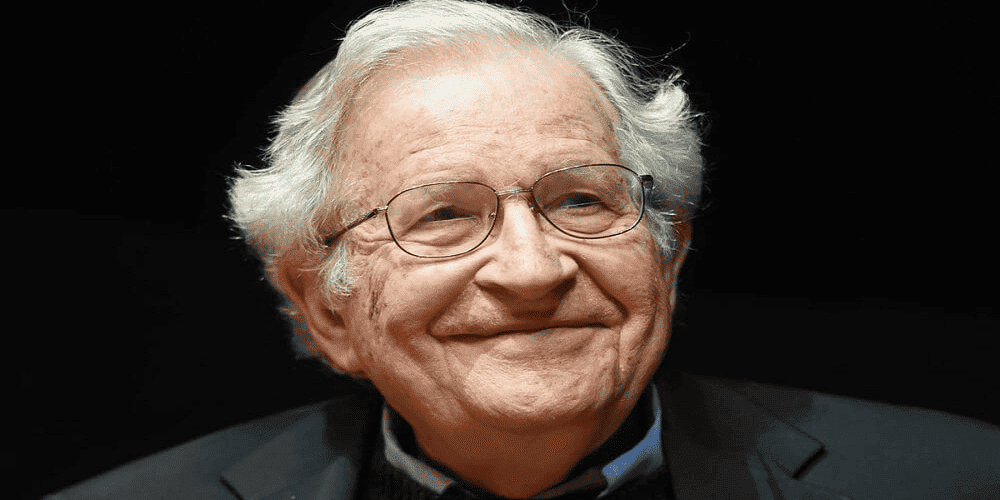
Noam Chomsky is one of the most influential intellectuals of the modern era. Known worldwide for his groundbreaking work in linguistics and his strong political critiques, Noam Chomsky has shaped how people understand language, power, media, and global politics. His ideas continue to influence students, researchers, activists, and thinkers across the world.
For more than seven decades, Noam Chomsky has challenged dominant narratives and encouraged people to think critically. Whether it is through his theory of universal grammar or his outspoken views on imperialism, capitalism, and media control, Noam Chomsky remains a central figure in academic and public debates.
Early Life and Education of Noam Chomsky
Noam Chomsky was born on December 7, 1928, in Philadelphia, United States. His parents were Jewish immigrants from Eastern Europe. His father, William Chomsky, was a Hebrew scholar and educator, which had a significant influence on Noam Chomsky’s intellectual development.
From an early age, Noam Chomsky showed a deep interest in language, history, and politics. He was exposed to discussions about social justice, Zionism, and anarchism during his childhood. These early influences later shaped his political ideology.
Noam Chomsky attended the University of Pennsylvania, where he studied linguistics, philosophy, and mathematics. Under the guidance of linguist Zellig Harris, he developed a strong interest in theoretical linguistics. His doctoral research laid the foundation for ideas that would later revolutionize the field.
Noam Chomsky and the Revolution in Linguistics
Noam Chomsky is often described as the father of modern linguistics. Before his work, linguistics focused mainly on describing languages rather than understanding the mental processes behind language use.
Universal Grammar Theory
One of the most important contributions of Noam Chomsky is the theory of universal grammar. According to this idea, humans are born with an innate ability to understand and produce language. This means that language learning is not just based on imitation but is hard-wired into the human brain.
Noam Chomsky argued that children can learn complex grammatical structures even when they are exposed to limited language input. This challenged behaviorist theories that viewed language learning as a result of habit formation.
Transformational-Generative Grammar
Another major contribution by Noam Chomsky is transformational-generative grammar. This theory explains how deep structures in the mind are transformed into surface structures in spoken language.
Through this approach, Noam Chomsky demonstrated that language follows rules that are often unconscious. His work changed linguistics from a descriptive discipline into a cognitive science.
Academic Career and MIT Years
Noam Chomsky spent most of his academic career at the Massachusetts Institute of Technology (MIT). He joined MIT in the 1950s and later became a full professor.
At MIT, Noam Chomsky mentored generations of linguists and researchers. His influence helped establish linguistics as a formal academic discipline in universities worldwide.
Even after retiring, Noam Chomsky continued to write, lecture, and engage in public discussions. His academic career spans more than 60 years, making him one of the longest-serving scholars in modern history.
Noam Chomsky’s Political Philosophy
Beyond linguistics, Noam Chomsky is widely known for his political activism and critique of power structures. He identifies as a libertarian socialist and anarcho-syndicalist.
Criticism of U.S. Foreign Policy
Noam Chomsky has been one of the strongest critics of U.S. foreign policy. He has spoken extensively about wars, military interventions, and the role of the United States in global conflicts.
From the Vietnam War to conflicts in the Middle East, Noam Chomsky has argued that powerful nations often act in their own interests while promoting narratives of democracy and freedom.
Views on Capitalism and Corporate Power
Noam Chomsky believes that unchecked capitalism leads to inequality and exploitation. He criticizes corporate dominance and argues that large corporations often undermine democracy.
According to Noam Chomsky, economic systems should prioritize human needs rather than profits. His ideas resonate strongly with labor movements and social justice activists.
Manufacturing Consent: Media and Propaganda
One of the most famous works by Noam Chomsky is Manufacturing Consent, co-authored with Edward S. Herman. This book introduced the propaganda model of media.
The Propaganda Model
The propaganda model explains how mass media serves elite interests by shaping public opinion. Noam Chomsky argues that media outlets are influenced by ownership, advertising, sourcing, and political pressure.
Rather than acting as neutral observers, media institutions often filter information in ways that support government and corporate agendas.
This work made Noam Chomsky a leading figure in media criticism and is frequently cited in discussions about fake news, bias, and information control.
Noam Chomsky on Education and Critical Thinking
Noam Chomsky places great importance on education and independent thinking. He believes that true education encourages curiosity and skepticism rather than obedience.
According to Noam Chomsky, modern education systems often focus on standardized testing and job preparation, neglecting creativity and critical thought. He encourages students to question authority and seek truth through evidence and reasoning.
His views have inspired educators and learners to rethink traditional teaching models.
Books Written by Noam Chomsky
Noam Chomsky has written more than 150 books covering linguistics, politics, philosophy, and media. Some of his most notable works include:
- Syntactic Structures
- Aspects of the Theory of Syntax
- Manufacturing Consent
- Hegemony or Survival
- Who Rules the World?
- Understanding Power
Each book reflects Noam Chomsky’s commitment to intellectual honesty and social responsibility.
Global Influence of Noam Chomsky
Noam Chomsky is often described as one of the most cited scholars in history. His work is studied in universities across continents.
He has influenced movements related to peace, labor rights, free speech, and environmental justice. Activists often quote Noam Chomsky to challenge dominant political and economic systems.
Despite facing criticism and controversy, Noam Chomsky remains respected for his consistency and depth of knowledge.
Criticism and Controversies
Like any influential thinker, Noam Chomsky has faced criticism. Some argue that his political views are overly idealistic or biased against Western democracies.
Others disagree with his interpretations of historical events. However, even critics acknowledge that Noam Chomsky raises important questions about power, ethics, and responsibility.
His willingness to engage with critics openly demonstrates his commitment to free debate.
Noam Chomsky in the Digital Age
In the age of social media and digital news, Noam Chomsky’s ideas about propaganda and media manipulation feel more relevant than ever.
He has spoken about how algorithms, corporate platforms, and online surveillance affect freedom of expression. Noam Chomsky warns that technology can be used to control populations if not regulated ethically.
His insights continue to guide discussions on digital democracy and information freedom.
Personal Life and Values
Noam Chomsky is known for living a relatively simple life. He has always emphasized moral responsibility over fame or wealth.
Despite global recognition, Noam Chomsky remains grounded and focused on education, activism, and writing. His personal values align closely with his public philosophy.
Legacy of Noam Chomsky
The legacy of Noam Chomsky extends far beyond academic papers and political speeches. He has transformed how people think about language, authority, and truth.
Future generations will continue to study Noam Chomsky not only as a linguist but as a moral thinker who challenged injustice.
His work reminds humanity that questioning power is essential for a healthy society.
Conclusion
Noam Chomsky is more than a scholar; he is a symbol of intellectual courage. From redefining linguistics to exposing power structures, Noam Chomsky has left an unmatched impact on modern thought.
His ideas encourage individuals to think critically, act ethically, and seek truth beyond propaganda. In a rapidly changing world, the teachings of Noam Chomsky remain deeply relevant and necessary.
Frequently Asked Questions (FAQs)
Who is Noam Chomsky?
Noam Chomsky is an American linguist, philosopher, political activist, and author known for his work in linguistics and criticism of media and politics.
Why is Noam Chomsky famous?
Noam Chomsky is famous for developing the theory of universal grammar and for his strong critiques of U.S. foreign policy and media propaganda.
What is Noam Chomsky’s theory of language?
Noam Chomsky proposed that humans are born with an innate language ability known as universal grammar, which helps children learn language naturally.
What are Noam Chomsky’s political views?
Noam Chomsky identifies as a libertarian socialist and criticizes capitalism, imperialism, and corporate power.
What is Manufacturing Consent about?
Manufacturing Consent explains how mass media shapes public opinion to support elite interests through a propaganda model.
Is Noam Chomsky still influential today?
Yes, Noam Chomsky remains highly influential in linguistics, political thought, media studies, and social activism.
How many books has Noam Chomsky written?
Noam Chomsky has written and co-authored more than 150 books across multiple disciplines.
Where did Noam Chomsky teach?
Noam Chomsky spent most of his teaching career at the Massachusetts Institute of Technology (MIT).
Leave A Comment
0 Comment