
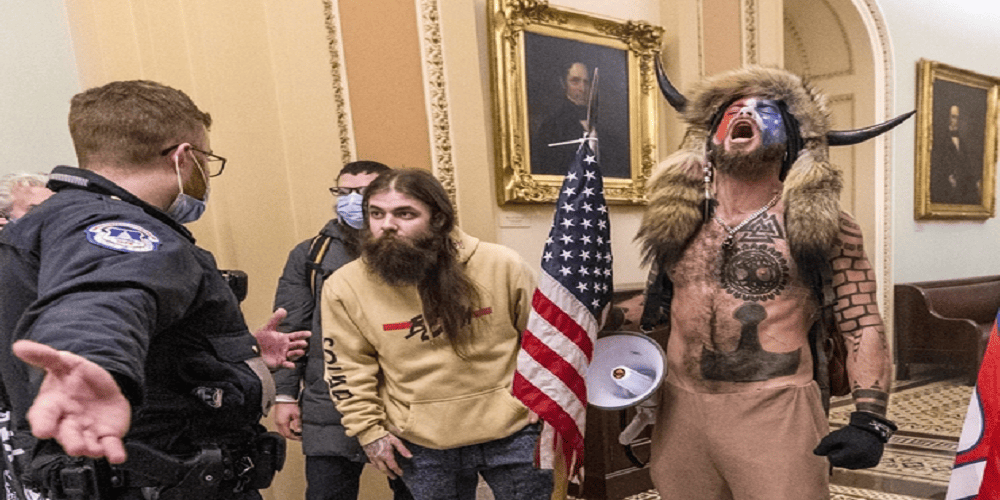
The name QAnon Shaman instantly evokes one of the most vivid and bizarre iconic images of the January 6, 2021, storming of the U.S. Capitol — a bare-chested man with horns, face paint, and a spear, wandering through the halls of Congress. But behind that striking image lies a more complex person, with beliefs, motivations, legal history, and shifting allegiances. In many ways, the “QAnon Shaman” is a microcosm of the broader QAnon movement: a figure combining conspiracy, spectacle, personal mythmaking, and political theatre.
In what follows, we trace:
- Who the QAnon Shaman is (real name, background)
- How he became associated with QAnon and January 6
- The symbolism and meaning behind his attire and persona
- His arrest, trial, sentence, and post-release developments
- How his relationship with the movement and former allies has evolved
- Broader implications and controversies
- Future prospects
- FAQs
Throughout, the goal is not to glorify or demonize, but to understand — in as objective a tone as possible — the life, choices, and role of this individual within a volatile ideological moment.
1. Identity and Early Life
Name and aliases
The person commonly referred to as the QAnon Shaman is Jacob Anthony Chansley, also known as Jake Angeli or “Jake Chansley.” Wikipedia+2Wikipedia+2 Over time, he has adopted or been given various monikers: Q Shaman, Yellowstone Wolf, America’s shaman (in his own rebranding), sometimes simply the Shamanic practitioner. Cronkite News+1
He is not, by training, a bishop, doctor, or institutional spiritual leader — his “shamanism” is self-declared, blending elements of New Age, mysticism, personal symbolism, and conspiracy narrative.
Background, education, and personal history
Chansley was born in 1988 (some sources 1987) and raised in Phoenix, Arizona. Cronkite News+3Wikipedia+3Wikipedia+3 His mother, Martha Chansley, is a single mother, and public reporting notes that Chansley had early interests in spirituality. Wikipedia+1 He attended Moon Valley High School and later enrolled at Glendale Community College, studying subjects such as psychology, philosophy, religion, and ceramics. Wikipedia+2Wikipedia+2 At one point, he also enlisted in the United States Navy (2005–2007) and served as a storekeeper’s assistant aboard the USS Kitty Hawk. Wikipedia+1 He later claimed that he was discharged for refusing a vaccination, though reporting is varied on the details. Wikipedia+2Cronkite News+2
Before rising to public attention, Chansley was involved in fringe activism, conspiracy content creation, and occasional protests. Wikipedia+2Cronkite News+2 He self-published books (e.g. Will & Power: Inside the Living Library) under the pseudonym “Loan Wolf” and One Mind at a Time: A Deep State of Illusion, seeking to articulate his worldview. Wikipedia+1 In media accounts, he sometimes invested heavily in mythic language, comparing himself to figures like Gandhi or Jesus (in terms of spiritual activism). Diario AS+2Cronkite News+2
He has also portrayed his identity as a “shamanic practitioner,” distinguishing between institutional or traditional “shaman” definitions and his own self-described spiritual mode. Cronkite News+1
2. Path to QAnon and January 6
QAnon and ideological alignment
QAnon is a conspiracy movement that emerged in 2017, rooted in cryptic “Q drops” (anonymous posts supposedly from someone with insider access) claiming that Donald Trump was secretly waging a battle against a cabal of Satanic, child-trafficking elites. Wikipedia+1 Over time the “Q drops” and conspiracy artifacts evolved, but the core mythos includes themes of secret war, apocalyptic justice, cosmic battle, and redemptive revelation.
Chansley gravitated toward this worldview, adopting many of its motifs: the idea of cosmic warfare, hidden truths, spiritual struggle, and a role as truth-bearer. ABC News+3Program on Extremism+3Cronkite News+3 He attended pro-Trump rallies that explicitly included QAnon adherents, and over time became one of its most visible personalities. Program on Extremism+2Cronkite News+2 His flamboyant aesthetic and performance style made him an easy candidate for viral fame among Q circles.
By Jan 6, 2021, the QAnon Shaman had become a recognizable presence in the pro-Trump, pro-“Stop the Steal” camp. ABC News+2Program on Extremism+2
The events of January 6
On January 6, 2021, a large crowd of Trump supporters stormed the U.S. Capitol in an attempt to intervene in the certification of Joe Biden’s electoral victory. During this assault, Chansley took on a distinctive role:
- He entered the Capitol building wearing a fur and horned headdress (coyote tail), with his upper body bare, facial paint, and carrying a spear with an American flag affixed. Cronkite News+4ABC News+4Wikipedia+4
- He used a bullhorn to chant and rally other rioters. Cronkite News+3ABC News+3Program on Extremism+3
- Within the Senate chamber, he posted a note on Vice President Pence’s desk saying, “It’s Only A Matter of Time. Justice Is Coming!” Cronkite News+3PBS+3ABC News+3
- He defended at his sentencing that he considered the Senate chamber a “sacred space,” invoking a quasi-spiritual justification for his presence. Cronkite News+3ABC News+3Wikipedia+3
Although he did not himself engage in violence against officers or property destruction (per prosecutors’ view), his appearance and role in the mob made him one of the most photographed and symbolically potent figures of the riot. PBS+2ABC News+2 Many media outlets identified him as among the first to breach the building. PBS+1
His performance within the Capitol was theatrical: gestures, chants, and posture all contributed to making him a viral image. In media commentary, he was dubbed “the public face” of the Capitol riot. PBS+2ABC News+2
3. Symbolism, Persona, and Meaning
The QAnon Shaman is not just a performer — his garb, props, and posture carry symbolic weight. To understand him, one must parse his visual semiotics and how they interface with conspiracy myth.
The horned headdress, body paint, and spear
- Horns and animal symbolism: The horned headdress, with coyote tail, evokes shamanistic, pagan, or animistic traditions in which horns or antlers signify connection to the spirit world, nature, or liminal realms. Chansley’s choice of a hybrid fur-horned look signals a boundary between the human and the wild, the seen and unseen.
- Bare torso and paint: The painted body and exposure suggest ritualic vulnerability and an invocation of raw, primal energy. In many religious or spiritual traditions, painted bodies signal initiation, transcendence, or liminality. Chansley’s usage channels the motif that he is not merely a participant but a ritual actor.
- Spear / flagpole: The six-foot pole with spearhead and American flag connects his spiritual persona with political symbolism: wielding the nation’s banner as a weapon, or merging national myth with mythic battle. Program on Extremism+3ABC News+3Wikipedia+
- Acting in sacred space: Chansley argued that the Senate chamber was a sacred place, that he entered to bring “good vibrations.” Program on Extremism+3Diario AS+3Cronkite News+3 He claimed that he prevented theft of muffins and maintained vibrational order. Diario AS
Self-mythologizing and spiritual narrative
Chansley’s identity is not static; he constantly reinterprets his role. Over time, he has tried to distance from the pure “QAnon” brand, preferring to be seen as a shamanic practitioner, or even America’s shaman. Cronkite News+1 He argues the “Q label” has become too encumbered, too stigmatized, associated with extremists and conspiracy baggage. Cronkite News
He has also compared himself to spiritual activists like Gandhi or Jesus in public statements, positioning his actions in a long tradition of spiritual protest. ABC News+3Diario AS+3Cronkite News+3
In such ways, Chansley frames himself not merely as a political actor but a mythic figure — a medium, a messenger, a hybrid shaman-politician.
4. Arrest, Prosecution, and Sentence
Arrest and charges
Chansley was arrested on January 9, 2021, days after the Capitol storming. Wikipedia+2ABC News+2 He was charged with multiple federal crimes including unlawfully entering a restricted building or grounds, violent or disorderly conduct, and obstruction of an official proceeding. Program on Extremism+3ABC News+3PBS+3
He pled guilty on September 3, 2021, to a single felony count of obstructing an official proceeding. Program on Extremism+3ABC News+3Wikipedia+3 In his plea, he acknowledged wrongdoing and accepted responsibility. PBS+2ABC News+2
Sentencing and incarceration
On November 17, 2021, Chansley was sentenced to 41 months (about 3 years and 5 months) in prison, which at the time was among the longest sentences given to any Jan 6 rioter. ABC News+2PBS+2 The judge in his case was Royce Lamberth, who has presided over multiple January 6 cases. Wikipedia+2Wikipedia+2
At sentencing, Lamberth noted the seriousness of Chansley’s conduct and said that despite his expression of remorse, the conduct could not be excused. ABC News+2PBS+2 Chansley himself told the court: “I have no excuse. No excuses whatsoever. My behavior is indefensible.” PBS+1
Though Chansley did not admit to acts of violence or destruction, prosecutors emphasized his role in galvanizing and symbolizing the riot, as well as ignoring orders to leave the Capitol. PBS+1
While incarcerated, Chansley made requests for religious accommodations (e.g. organic food) and other motions, some of which were denied or partially granted by judge Lamberth. Wikipedia+2ABC News+2
He was later transferred to a halfway house in Phoenix in 2023, and subsequently released (with supervised release) by May 2023. Wikipedia+3The Guardian+3Cronkite News+3
Return of property
In August 2024, a judge ordered the Department of Justice to return Chansley’s seized horned helmet and spear as part of his personal property, arguing the government had not shown it needed them as evidence. ABC News
5. Post-Release, Political Ambitions, and Shifting Alliances
Rebranding and congressional campaign
After his release, Chansley announced a bid for Congress in Arizona’s 8th Congressional District, and declared that he no longer wanted to be known strictly as the “QAnon Shaman.” Cronkite News+1 He described himself as a “shamanic practitioner,” and expressed desire to rebrand (e.g. “America’s shaman”) to distance from the QAnon brand’s stigma. Cronkite News Some analysts viewed the campaign as a long shot, in part because his prior image is so difficult to escape. Cronkite News+1
In running, he said he would not accept PAC money and would rely on grassroots attention and media visibility. WIRED+1 Some observers noted that his candidacy is not an outlier in Arizona, where several extremist or election denial candidates were seeking office. WIRED
However, his efforts to separate from QAnon meet headwinds — many Americans and media see him first as QAnon’s poster figure, making rebranding difficult. Cronkite News+1
Break with Trump and internal fissures
At a surprising turn, Chansley has become increasingly critical of Donald Trump. In mid-2025 he publicly blasted Trump, calling him a “fraud,” questioning his ties to Jeffrey Epstein, and using profanity in his posts. Cronkite News+4People.com+4The Independent+4 He expressed skepticism over the Trump administration’s failure to release Epstein documents and accused Trump of betrayal in the Q narrative. The Daily Beast+2The Independent+2
This shift is notable because Chansley was once a fervent Trump supporter. His new posture reflects growing tensions within the QAnon / MAGA ecosystem, with some hardliners feeling disappointed by Trump’s reluctance to fully deliver on Q’s promises. The Independent+2People.com+2
Media commentary has seized on this as a possible sign of unraveling within the extremist fringe — when even one of the movement’s iconic figures grows disillusioned, it raises questions about credibility and cohesion. People.com+3TheWrap+3The Independent+3
Pardons in 2025 and consequences
On January 20, 2025, President Donald Trump issued pardons to many January 6 defendants, including Chansley. People.com+4Cronkite News+4Program on Extremism+4 After receiving the pardon, Chansley celebrated publicly, declaring that he would purchase firearms (believing his rights restored). People.com+3Cronkite News+3Wikipedia+3
Still, his shift in tone toward Trump suggests the pardon did not cement loyalty. He now criticizes Trump on issues like Epstein, making clear that his trajectory is not linear. People.com+2Program on Extremism+2
These developments illustrate a dynamic pattern: from loyal foot soldier, to symbolic icon, to renegade challenger in his own community.
6. Broader Significance, Critiques, and Controversies
Icon of spectacle and radicalization
The QAnon Shaman’s value to the QAnon movement has been partly symbolic: his image helped dramatize the movement’s mythos. A man who appears to bridge spectacle, ritual, and politics becomes a living totem of conspiracy. In that sense, Chansley is a kind of performance art turned real.
His prominence also raises questions about radicalization pathways: how fringe beliefs, internet lore, identity seeking, and spiritual language combine to produce individuals willing to storm critical institutions. He embodies how mythology, narrative, and personal vocation can fuse in modern conspiracy spaces.
Mental health, credulity, and narrative complexity
Media and analysts have sometimes speculated about Chansley’s mental health or psychological state. Some suggest that his adoption of extreme beliefs, self-mythologizing, and performative posture reflect a personality drawn to boundary states. However, making clinical or psychiatric judgments is fraught and ethically problematic. Instead, it may be more accurate to say that Chansley’s path illustrates how some individuals find meaning and identity in conspiratorial myth, especially in a social environment saturated with alienation, distrust, and narrative voids.
The challenge is that extremism discourse often oscillates between demonization and dehumanization. While Chansley’s actions are legally punishable and socially harmful, understanding him requires grappling with cognitive, emotional, and symbolic forces that animate conspiracy belief.
Legal and political implications
Chansley’s prosecution, sentencing, and later pardon elucidate several legal and political fault lines:
- Proportionality and accountability: Although he was not directly violent, his symbolic role made his sentence heavier. The justice system had to decide how to handle symbolic actors in mass protests.
- Pardon politics: The 2025 pardons (including Chansley’s) ignited debates on whether political violence is being absolved in service of political agendas. Critics argue pardoning violent or disruptive actors sets dangerous precedents for accountability in democracy. Cronkite News+2Program on Extremism+2
- Free speech versus insurrection: Chansley and others claimed political justification, invoking free speech and protest rights. The courts generally drew a boundary when actions crossed into obstruction, trespass, or incitement.
Tensions within conspiracy subcultures
Chansley’s later break with Trump reflects deeper fractures in conspiracy ecosystems. Some believers feel betrayed when their messianic expectations go unmet or when political leaders fail to deliver. Chansley’s criticism of the Epstein file handling is emblematic: he remains committed to Q’s core narratives and is now confronting perceived failure. That internal critique can erode cohesion or generate splinters.
Additionally, the attempt to rebrand away from “QAnon Shaman” signals the cost of being tethered too tightly to conspiracy identity — once you become iconic, you may struggle to evolve.
7. What’s Next? Prospects and Trajectories
Political viability
Chansley’s congressional bid is ambitious but faces structural challenges. His legal past, bizarre imagery, and ongoing associations with Q raise skepticism from mainstream voters. While fringe zones may embrace him, winning a broad electorate would require significant rebranding and moderation. Given the scrutiny he faces, it is unlikely (at least in the near term) he becomes a serious legislator — though even a campaign can amplify visibility and narrative claims.
Narrative pivots and myth evolution
Chansley may continue to evolve his public identity, perhaps leaning further into spiritual or mystical language rather than explicitly political or conspiracy frames. If he succeeds in distancing from Q, he may position himself as a metaphysical critic or outsider truth-speaker. Alternatively, he may double down into conspiratorial extremes, further estranging from electoral politics.
His break with Trump might also inspire others who supported Q but were disillusioned with Trump’s performance. In that sense, Chansley could become a rallying figure for second-wave conspiracists seeking alternatives.
Symbolic afterlife
Even if Chansley fades from public campaigns, his image is now part of collective memory: the horned, painted man in the Capitol will be reprinted in books, documentaries, art, and political commentary. The mythic potency of his performance ensures a kind of symbolic immortality. Future movements (domestic or global) may repurpose his icon or adapt parts of his persona as signifiers of rebellion or refusal.
He also may remain a figure of media fascination — an archetype of fringe truth-seeking in a polarized age.
8. Frequently Asked Questions (FAQs)
Q1: Why is he called the “QAnon Shaman”?
Because he was a prominent visible supporter of QAnon and adopted a shamanic aesthetic (horns, paint, ritual posture). His alignment with the movement, presence, and performance made him a natural symbol of “Q + shamanism.”
Q2: Did he commit violence or kill anyone?
No — prosecutors did not charge him with assault or homicide. His felony charge was obstructing an official proceeding, and he was not accused of direct violent acts or property destruction. Wikipedia+3PBS+3ABC News+3
Q3: Why did he get 41 months if he wasn’t violent?
Because the justice system considered not only direct violence but also symbolic incitement, defiance, and conspicuousness. His prominent role, ignoring police orders, using a bullhorn, entering legislative chambers, and propagating mythic claims elevated his culpability in the public view. The judge considered the seriousness of undermining institutional order. ABC News+2PBS+2
Q4: Was he pardoned?
Yes. In 2025, Donald Trump granted pardons to more than 1,500 January 6 defendants, including Chansley. People.com+3Cronkite News+3Program on Extremism+3
Q5: Why has he turned against Trump now?
Chansley’s shift likely derives from disillusionment with unmet promises (especially around Epstein documents), intra-movement tensions, and a desire to reclaim narrative control. He accused Trump of fraud and betrayal. The Independent+2The Daily Beast+2
Q6: Is his “shamanism” real or metaphorical?
It is self-declared and idiosyncratic rather than institutionally established. His “shamanic practitioner” identity seems to function narratively and symbolically, not as recognized traditional shamanism. He himself has clarified that he doesn’t claim to be a classic shaman, but practices shamanism in his own way. Cronkite News+1
Q7: Can he run for Congress if he was convicted?
Yes, in the U.S. many jurisdictions allow individuals with felony convictions (if their civil rights are restored) to run for office. Chansley did announce a campaign for a House seat in Arizona, though not as a major contender. Cronkite News+2WIRED+2
Q8: What does his case teach us about conspiracy movements?
His trajectory illustrates how conspiracism, myth, identity, and spectacle intersect. It shows how someone can reframe themselves as spiritual warrior, how beliefs can embed in identity, and how ideological movements can both uplift and later discard icons. It also reveals tensions between accountability, radicalism, and narrative loyalty.
Leave A Comment
0 Comment