
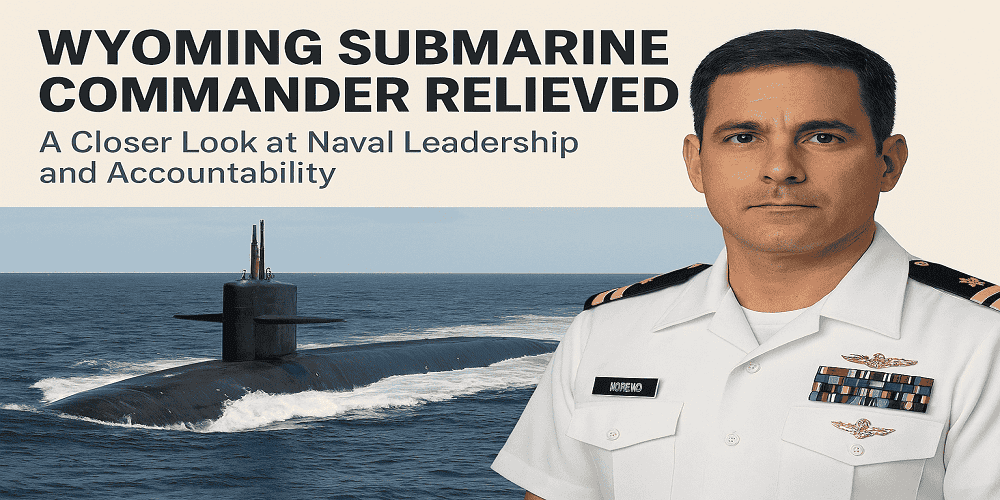
In October 2025, the U.S. Navy publicly relieved Commander Robert Moreno from his post as commanding officer of USS Wyoming (SSBN-742), citing a “loss of confidence” in his ability to command. Yahoo+3Navy Times+3The Economic Times+3 This development attracted attention because command of a ballistic missile submarine is one of the most consequential and sensitive commands in the U.S. Navy, involving strategic nuclear deterrence, high technical demands, and tight trust in leadership.
To understand this fully, one must examine both the background and structure of the submarine (USS Wyoming), the role and responsibilities of its COs, the circumstances as publicly disclosed, and possible inferences.
This narrative proceeds in roughly the following order:
- Overview of USS Wyoming (SSBN-742)
- The role of a submarine commanding officer (especially in SSBNs)
- Known career and tenure of Robert Moreno
- Public reporting on his removal
- Possible reasons and implications
- Broader context regarding “loss of confidence” removals in the U.S. Navy
- What comes next for USS Wyoming
- FAQ
1. Overview of USS Wyoming (SSBN-742)
Basic facts and history
- USS Wyoming (SSBN-742) is an Ohio-class ballistic missile submarine in the U.S. Navy’s fleet. Navy Times+5Wikipedia+5sublant.usff.navy.mil+5
- The Ohio-class is the backbone of the U.S. sea-based nuclear deterrent. Each SSBN (Ship, Submersible, Ballistic, Nuclear) carries Trident ballistic missiles.
- Wyoming was built by General Dynamics Electric Boat in Groton, Connecticut. sublant.usff.navy.mil+2Wikipedia+2
- Her keel was laid on 8 August 1991, launched on 15 July 1995, and she was commissioned on 13 July 1996. sublant.usff.navy.mil+2Wikipedia+2
- Her home port is Kings Bay, Georgia (Naval Submarine Base Kings Bay). Navy Times+3Wikipedia+3sublant.usff.navy.mil+3
- The submarine’s motto is "Cedant Arma Togae" (Latin: “Force must yield to law”) according to its official site. sublant.usff.navy.mil
- It operates under a dual-crew structure (Blue and Gold crews) typical of U.S. strategic submarines, allowing one crew to rest and train while the other is at sea. sublant.usff.navy.mil+1
- As of the time of the removal news, the Blue crew’s commanding officer was Robert Moreno. sublant.usff.navy.mil+2Navy Times+2
Capabilities and role
- The Ohio class boats each carry up to 24 missile tubes (Trident II D5) as their strategic deterrent payload. sublant.usff.navy.mil+2Wikipedia+2
- They also have torpedo tubes (typically 4) for self-defense and closer-range threats. sublant.usff.navy.mil
- Displacement is substantial (on the order of ~18,750 tons submerged) and length is about 560 feet (approx. 170–180 meters) with a beam near 42 feet. sublant.usff.navy.mil+2Wikipedia+2
- Submerged speeds exceed 20 knots. Navy Times+3Wikipedia+3sublant.usff.navy.mil+3
- The strategic mission is deterrence patrol: remaining hidden, maintaining survivability, and ensuring that adversaries cannot eliminate the submarine leg of the nuclear triad.
- During maintenance periods, the submarine is typically docked or in shipyard, undergoing repairs, refits, or modernizations.
Thus, USS Wyoming is not a front-line attack submarine but a core asset in U.S. strategic deterrence. Leadership of such a vessel is intrinsically high-stakes.
2. Role and responsibilities of a submarine CO (especially SSBN)
Understanding the role helps explain why a “loss of confidence” removal is serious.
Commanding officer responsibilities
A commanding officer (CO) of a submarine, particularly an SSBN, is entrusted with:
- Operational readiness and safety of the submarine, its crew, and associated weapon systems
- Navigation, stealth, and submergence/emergence operations under complex conditions
- Weapon system operations, including the management, security, handling, and deployment of ballistic missiles
- Training, morale, discipline, and welfare of the crew
- Maintenance oversight, ensuring the submarine is technically sound
- Compliance with legal, regulatory, and security protocols, including classification, nuclear operations, and rules of engagement
- Command decision-making under uncertain, restricted, or stressful conditions
- Coordination with higher command, fleet authorities, and strategic commands
- Upholding integrity, trust, and example — in the submarine community, the conduct of a CO is under continuous scrutiny
Because SSBNs are strategic assets, their COs often undergo particularly rigorous vetting, training, and oversight. Mistakes or lapses in judgment — be they administrative, procedural, ethical, or otherwise — may have serious implications.
The dual-crew model and command handovers
Ohio-class SSBNs typically operate with two crews, “Blue” and “Gold”, that rotate. This allows more continuous deployment, less downtime, and sustained patrol coverage. The COs of each crew must ensure continuity, handovers, training, and synchronization of standards between crews.
Additionally, because the submarine may go through long maintenance or overhaul periods, the CO must manage transitions between operational status, dry dock periods, modernization, and back to deployment.
Given all this, the removal of a CO for “loss of confidence” suggests something went awry that undermined trust in his ability to continue safely handling these responsibilities.
3. Known career and tenure of Robert Moreno
Publicly available information about Commander Robert Moreno is limited, but some points are documented.
Tenure on USS Wyoming
- According to the USS Wyoming official page, Cmdr. Robert Moreno was the Blue Crew commanding officer at least as of recent listing. sublant.usff.navy.mil
- He had assumed command on 14 May 2024. Navy Times+2The Economic Times+2
- He was temporarily reassigned to Naval Submarine Base Kings Bay, Georgia, after his removal. Navy Times+1
Earlier career (as publicly reported)
- According to a Navy press release and reporting, Moreno earned his commission in 2005. Navy Times+1
- Before his Wyoming command, he had reportedly served at Commander Joint Force Maritime Component and Submarine Force Atlantic, both based in Norfolk, Virginia. Navy Times+1
- Some news reporting claims he began his naval career as an enlisted sailor before commissioning, though the precise path and assignments are less clear in public sources. Bangla news+1
It is notable that much of Moreno’s full service record is not publicly disclosed, which is not uncommon for senior submarine commanders given operational security and classification constraints.
4. Public reporting on his removal
Announcement and rationale
On October 9, 2025, the Navy publicly announced that Cmdr. Moreno had been relieved from command of USS Wyoming (Blue Crew). Navy Times+2The Economic Times+2 The stated reason was “loss of confidence in his ability to command.” Navy Times+1
Rear Admiral Bob Wirth, the commander of Submarine Group Ten, made the decision. Navy Times+1 The Navy’s statement emphasized that commanding officers are held to “high standards of personal and professional conduct,” and that they must be accountable when they do not meet those standards. Navy Times+1
No further details or allegations were disclosed publicly regarding misconduct, performance, or specific incidents leading to the decision. Navy Times+2The Economic Times+2
Interim command
Following Moreno’s relief, Capt. David Burke, deputy for training at Submarine Squadron 20, assumed interim command of USS Wyoming during the transition. Navy Times+1
The Navy also noted that Wyoming was undergoing maintenance, and that the change in command would not disrupt the submarine’s schedule or ongoing maintenance work. Navy Times+2The Economic Times+2
Media coverage and context
Media outlets emphasized that such removals are not unusual in the Navy, often under the catch-all phrase “loss of confidence.” Navy Times+2The Economic Times+2 One report noted that 2025 has already seen a spate of senior leadership changes in the Navy—COs, flag officers, and others. Navy Times+1
However, none provided verifiable detail about what exactly triggered the decision in Moreno’s case.
5. Possible reasons and implications
Because public statements offer only the phrase “loss of confidence,” we must consider what that phrase usually covers in naval and military command contexts. It is deliberately vague, often used when the Navy cannot publicly disclose the detailed underlying causes (which might involve classified operational matters or personnel issues). Below are plausible categories and their potential implications.
Possible categories of cause
- Operational or technical failure
- A serious mistake or oversight in submarine operations, navigation, safety, or mission readiness
- A failure in maintenance oversight, equipment readiness, or safety protocols
- Breach of nuclear operations standards, missile handling, or classification/security errors
- Leadership, personnel & morale issues
- Loss of trust among subordinate officers or crew regarding conduct, integrity, or consistency
- Poor handling of disciplinary issues, morale, or training deficiencies
- Breakdown in crew cohesion or failure to maintain command climate
- Conduct or ethical issues
- Violations of Navy codes of conduct (could be financial, personal, or moral)
- Misuse of authority, conflict of interest, or unreported behavior
- Issues with personal behavior (e.g. relationships, substance abuse)
- Administrative or policy failures
- Failure to comply with reporting, regulations, or inspections
- Lapses in documentation, audits, or adherence to Navy-wide standards
- Health, fitness, or judgment concerns
- Decline in physical, mental, or cognitive capacity (though public statements rarely attribute it directly)
- Demonstrated impairment or inability to perform under stress
Given that the public statement emphasizes “ability to command”, the cause more likely falls into performance, leadership, or trust-related categories rather than trivial administrative errors.
Why the Navy uses “loss of confidence”
- Discretion and classification: Many details cannot be publicly revealed due to national security, classification, or privacy concerns.
- Flexibility: The phrase allows the Navy to act decisively without pronouncing legal findings, guilt, or releasing private personnel records.
- Preserving service integrity: The Navy must maintain public confidence in command at all levels, so addressing apparent breakdowns is critical.
- Avoiding drawn-out public investigations: Using a concise standard avoids long public disputes or litigation in many cases.
Implications
- For Robert Moreno: His future career trajectory is uncertain. Being relieved for loss of confidence can stall advancement, lead to reassignment, or require remediation.
- For USS Wyoming and crew: The change raises questions about internal morale, continuity, and trust. However, the fact that the change is timed during maintenance reduces the risk to operational patrols or strategic posture.
- For the Navy and deterrent posture: The Navy must quickly restore stable, credible leadership to ensure no gap in command or misunderstandings. Signals to internal officers and public reaffirmation of standards are important.
- For public perception and media: It opens scrutiny on Navy leadership oversight, accountability, and internal culture, especially in a year where multiple leadership changes have been reported.
6. Broader context: “loss of confidence” removals in the U.S. Navy
Relief of commanding officers — especially in major commands — is neither new nor rare in U.S. naval history. Historically and in contemporary times, such removals serve as a vital accountability tool. Here are key relevant aspects:
Precedents
- Over the years, numerous COs have been removed for “loss of confidence” under various circumstances (e.g. ship collisions, failure to meet standards, morale breakdowns).
- The Navy often uses this phrase for dismissals when detailing the specific misconduct publicly would compromise security or privacy.
- The fact that 2025 has already seen several high-level firings suggests increased scrutiny or systemic pressures on Navy leadership. Navy Times+1
Patterns in timing and publicity
- These removals often occur during periods when certain weaknesses become visible (after inspections, during maintenance, after critical missions).
- Public announcements are often short, with minimal detail, to avoid speculation or undermining morale.
- Interim commands are promptly appointed to maintain operational continuity.
Challenges
- Morale and retention: Subordinate officers and crews may be unsettled, especially if the reasons are not disclosed.
- Reputational risk: The Navy must balance transparency and protecting reputations or classified information.
- Precedent effects: Officers may feel pressure or insecurity in command, affecting risk-taking or innovation.
- Political and media scrutiny: High-profile removals invite media commentary and may raise questions in Congress or oversight forums.
7. What comes next for USS Wyoming
Given standard Navy procedures and the public statements, likely next steps include:
- Appointment of a permanent CO
- Capt. David Burke (interim) may remain until higher authority selects a permanent successor
- The selection process will consider prior command experience, crew compatibility, and strategic reliability
- Internal review and investigation
- The Navy may conduct further assessments, interviews, or review logs, technical records, and crew feedback (possibly behind closed doors)
- Findings (if unclassified) could become known later
- Continuity for the crew
- The new CO must stabilize morale, validate trust, and ensure operations and training continue
- Ensuring alignment between Blue and Gold crews will be critical
- Return to patrol status
- Once maintenance concludes, Wyoming must resume deterrent patrols under strong leadership
- Any command disruptions must not weaken strategic posture
- Monitoring of Moreno’s reassignment or career
- Publicly, Moreno has been temporarily reassigned to Kings Bay. Navy Times+1
- His future role will depend on internal evaluations and any remedial or disciplinary outcomes
8. FAQ
Below is a set of frequently asked questions (and answers) about this situation, based on available information and common naval practice.
Q1: What exactly is USS Wyoming (SSBN-742)?
A1: USS Wyoming is an Ohio-class ballistic missile submarine commissioned in 1996, homeported at Kings Bay, Georgia. It operates as part of the U.S. strategic nuclear deterrent, with dual Blue and Gold crews. Navy Times+4sublant.usff.navy.mil+4Wikipedia+4
Q2: Who is Robert Moreno?
A2: Robert Moreno was the commanding officer of USS Wyoming’s Blue Crew, having assumed command in May 2024. He was relieved in October 2025 by the Navy citing a "loss of confidence" in his ability to command. Navy Times+2The Economic Times+2
Q3: What does “loss of confidence” mean?
A3: In naval practice, “loss of confidence” is a formal but broad term indicating the higher command no longer trusts the CO’s ability to lead. It may cover operational, leadership, ethical, or administrative failures. The Navy often uses it without public disclosure of specific underlying causes.
Q4: Did Moreno commit a crime or was any misconduct disclosed?
A4: No public evidence or formal charges have been disclosed in connection with Moreno’s removal. The Navy announcement provided no details beyond loss of confidence. Navy Times+1
Q5: Who has taken over command of USS Wyoming?
A5: Capt. David Burke, Deputy for Training at Submarine Squadron 20, has been named interim commanding officer during the transition. Navy Times+1
Q6: Will this affect the submarine’s mission or schedule?
A6: According to Navy statements, no. USS Wyoming was undergoing maintenance at the time and that change in command is not expected to disrupt its schedule. Navy Times+1
Q7: Is it common for submarine COs to be relieved?
A7: While not routine, CO reliefs do occur, especially when a significant leadership or performance issue is perceived. The Navy views such actions as necessary to maintain discipline, trust, and operational integrity.
Q8: What happens to Moreno now?
A8: He has been temporarily reassigned to Naval Submarine Base Kings Bay. His future assignments or possible investigations (if any) are not publicly known at this time. Navy Times+1
Q9: Could further information be revealed later?
A9: Yes — sometimes, after internal review or when classification allows, more details may be disclosed. But that is not guaranteed.
Q10: Does this impact U.S. nuclear deterrence?
A10: At present, the Navy assures continuity and minimal operational disruption. Because the submarine was in maintenance, the strategic posture should not be compromised. The Navy must restore stable command for long-term assurance.
Conclusion
The removal of Cmdr. Robert Moreno from command of USS Wyoming is a notable event given the importance of SSBN command roles. While public reporting provides only limited detail — essentially the phrase “loss of confidence” — the implications are serious: they touch on trust, competence, leadership, and the operational integrity of one of America’s key strategic assets.
Without more transparency or later disclosures, much of what lies behind this decision remains speculative. But by understanding the intense burdens of submarine command, the Navy’s practices around CO reliefs, and the operational imperatives of strategic deterrence, one can see why such a change would not be taken lightly.
Leave A Comment
0 Comment