
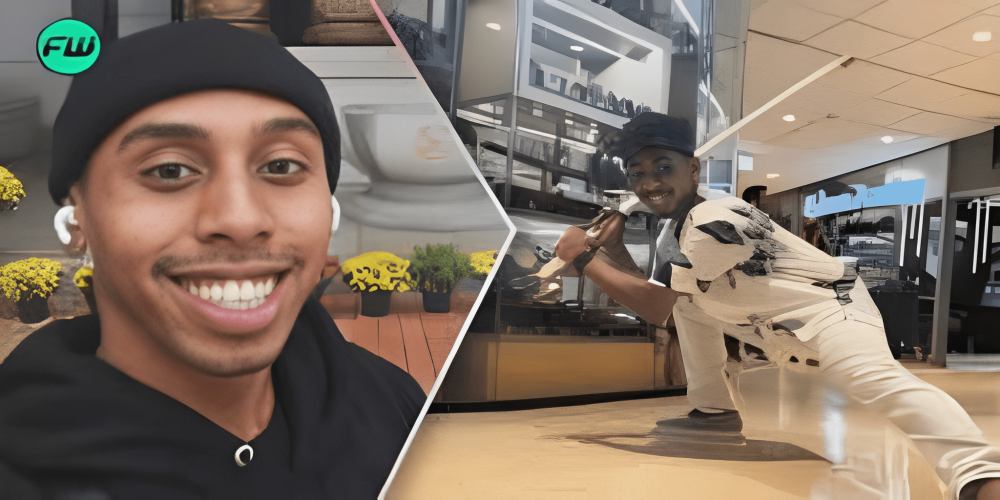
In the chaotic world of livestreaming, where attention is the ultimate currency, few have traded their freedom for views as spectacularly as Johnny Somali. While many streamers push boundaries to entertain, the American national, whose real name is Ramsey Khalid Ismael, turned international harassment and cultural desecration into a brand.
For months, the internet watched a bizarre game of cat and mouse play out on the streets of Seoul. However, that game concluded definitively in April 2026. A South Korean court handed down a prison sentence that has sent shockwaves through the streaming community, raising a critical question: Where is the line between "trolling" and terrorism?
This deep dive explores the life, crimes, and conviction of Johnny Somali, analyzing how a man with a small following managed to make international headlines for all the wrong reasons.
Who is Johnny Somali? The Man Behind the Mayhem
To understand the severity of the legal punishment, one must first understand the persona of Johnny Somali. Born Ramsey Khalid Ismael on September 26, 2000, in Phoenix, Arizona, his biography is a patchwork of audacious claims and verified facts .
He has claimed a heritage rooted in Somali and Oromo descent, and at various points, he has asserted he was a former child soldier or a pirate. These claims are widely disputed and largely considered fabrications designed to build a "tough guy" mythos for his online persona . In reality, he reportedly grew up in Scottsdale, Arizona, and claimed to have studied finance at Arizona State University, though his traveling lifestyle suggests academia was never his priority .
Johnny Somali began his streaming career in May 2023. Unlike gamers or IRL (In Real Life) explorers who showcase culture, Ismael specialized in "nuisance streaming"—intentionally disrupting public peace to elicit angry reactions. His content strategy was simple: trespass, insult locals, play loud, offensive audio in quiet spaces, and stream the resulting confrontation to platforms like YouTube and Kick .
Despite a relatively modest following (hovering around 5,000 on YouTube at his peak), his content was explosive. He was banned from nearly every major platform, including Twitch, Kick, Rumble, and Parti, for violating harassment and hate speech policies . Yet, like a digital nomad of chaos, he kept finding new homes online until the real-world legal system caught up with him.
The Japan Campaign: A Warning Ignored
Before Johnny Somali ever set foot in South Korea, he had already left a trail of destruction across Japan. His 2023 antics in Tokyo and Osaka served as a warning that the world largely ignored until it was too late.
In Japan, Johnny Somali displayed a specific tactic that he would later refine in Seoul: the weaponization of historical trauma. He famously taunted Japanese subway commuters about the atomic bombings of Hiroshima and Nagasaki. For a nation where the nuclear attacks are a deep, unhealed scar, hearing a foreigner yell about "bombing Japan again" on a packed train was an incitement to violence, not a prank .
He escalated his behavior by trespassing on a hotel construction site in Osaka, screaming "Fukushima" at workers—a reference to the devastating 2011 nuclear disaster. He and an accomplice were arrested under suspicion of trespassing and obstruction of business . In another incident, he blasted loud music in a family restaurant, disrupting business. When brought before a Japanese court, he attempted to blame a "Chinese virus" on his phone for the noise, a defense the judge rejected. He was fined 200,000 yen (approx. $1,400) and deported .
Japan gave him a slap on the wrist. Johnny Somali seemingly interpreted this leniency not as a lucky break, but as a license to escalate.
The South Korea Livestreams: Crossing the Final Line
When Johnny Somali arrived in South Korea in late 2024, he brought his playbook of provocation. However, he failed to understand that South Korean netizens and the legal system operate with a different level of intensity regarding national sovereignty and historical dignity.
His early stunts in Seoul were "standard" for him: disruptions on the subway, playing obscene videos in public, and harassing customers at convenience stores. He was banned from a bus for blasting North Korean propaganda music—a deeply offensive act in a country still technically at war with the North . These actions earned him local backlash; he was chased, punched, and assaulted by ordinary citizens who recognized him .
But the act that sealed his fate occurred in October 2024. Johnny Somali approached the "Statue of Peace" (Sonyeosang) in Seoul. This statue commemorates the "comfort women"—tens of thousands of Korean women and girls who were forced into sexual slavery by the Imperial Japanese Army during World War II. For Koreans, this statue is a symbol of unresolved pain, resilience, and the ongoing fight for historical recognition.
In a livestream that went viral before being removed, Johnny Somali kissed the statue and performed a lewd dance (twerking) next to it . The reaction in South Korea was immediate and volcanic. What was "trolling" to him was an act of profanity against the nation's grandmothers and its history.
The Apology and the Arrest
Realizing the storm he had created—or perhaps just the danger he was in—Johnny Somali attempted damage control. He posted an apology video, claiming he was "not aware of the significance of the statue" .
To South Koreans, this ignorance was not an excuse; it was the indictment. By traveling to a foreign country and touching sacred cultural symbols without basic research, he proved his reckless disregard. The apology was seen as insincere, a calculated move to avoid physical harm rather than genuine remorse.
The legal machinery moved swiftly. Johnny Somali was banned from leaving the country. He was indicted on multiple charges, including:
- Obstruction of business (for the convenience store and bus disruptions).
- Violation of minor public order laws.
- Distributing sexually explicit deepfake content (allegations included creating AI-based explicit content of female streamers) .
He remained trapped in South Korea, unable to flee back to the US, as the prosecution built its case. Even during his trial, he showed contempt for the court, reportedly wearing a "Make America Great Again" hat to a hearing and telling reporters that "Korea is a subordinate country of the United States" .
The Sentencing: 6 Months in Prison
On April 15, 2026, the Seoul Western District Court delivered its verdict. Johnny Somali was sentenced to six months in prison and an additional 20 days of detention. He was immediately remanded into custody from the courtroom .
The court found him guilty of all charges. The judges noted that Johnny Somali "repeatedly committed crimes for personal profit through online platforms," displaying a "serious disregard for South Korean law and order" .
It is important to note the discrepancy between the prosecution’s request and the final sentence. Prosecutors had asked for three years. The court handed down six months. Why the leniency? The court cited the "absence of severe harm to specific victims" and the fact that Johnny Somali had been stuck in the country under a travel ban for an extended period prior to sentencing .
While six months is relatively short, the secondary penalties are devastating for his future. The court imposed a five-year ban on Johnny Somali from working at any institution related to children, adolescents, or the disabled—a standard penalty in Korea for sex-crime related offenses (linked to the deepfake charges) .
The Aftermath and Global Implications
The imprisonment of Johnny Somali marks a turning point in the era of "IRL trolling." For years, streamers have flown to countries with weaker legal protections (or expensive legal systems) to harass locals for content. South Korea made an example of Ismael to deter others.
While some critics argue that the US State Department should intervene, legal experts note that Johnny Somali is subject to the laws of the country he visits. Ignorance of the significance of the Statue of Peace is not a legal defense.
Upon his release (scheduled for late 2026), Johnny Somali will face a world where he is banned from every major streaming platform and has a criminal record. His net worth, once estimated as high as $3 million (largely unverified and likely inflated by clickbait sites), is likely drained by legal fees .
Conclusion
Johnny Somali wanted attention. He wanted to be the villain the internet loved to hate. He succeeded, but the price was his liberty.
His story is a cautionary tale for the digital age: the internet is not a sovereign nation. When you use your keyboard or camera to commit crimes in the physical world, the physical world will eventually answer back. South Korea valued its dignity more than Johnny Somali valued his freedom, and for the next six months, he will sit in a cell contemplating the difference between a prank and a felony.
Short FAQs
1. What did Johnny Somali do to get arrested?
Johnny Somali was arrested for kissing and performing lewd acts on the "Statue of Peace" in Seoul, which honors Korean women forced into sexual slavery during WWII. He also faced charges for disrupting public transportation, playing North Korean propaganda, and distributing deepfake content.
2. How long is Johnny Somali in jail for?
He was sentenced to six months in prison plus 20 days of detention by the Seoul Western District Court on April 15, 2026. He was taken into custody immediately following the verdict.
3. Is Johnny Somali actually Somali?
No. While his stage name is Johnny Somali, his legal name is Ramsey Khalid Ismael. He was born in Phoenix, Arizona, and is an American citizen. He has claimed Somali and Ethiopian heritage, but many of his biographical claims are disputed.
4. Where is Johnny Somali now?
As of April 15, 2026, Johnny Somali is in South Korean custody serving his prison sentence. He will be incarcerated for six months, followed by deportation (likely back to the United States) unless further charges are pending.
5. Why didn’t he get the 3-year sentence?
The prosecution requested three years, but the court cited the "absence of severe harm to specific victims" and considered the time he had already spent restricted in South Korea under a travel ban as mitigating factors.
Leave A Comment
0 Comment