
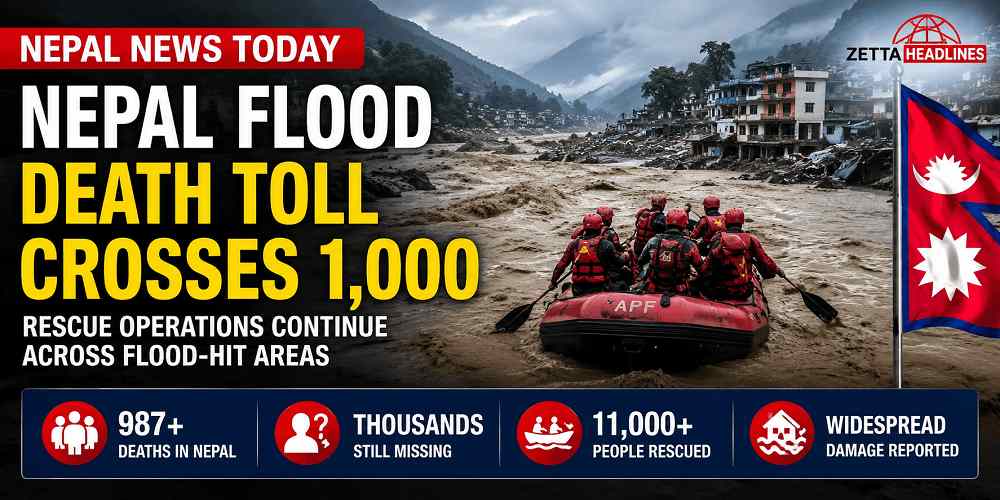
If you are searching for nepal news today, the country is currently facing one of its most serious natural disasters of recent times. Severe flash floods and landslides have disrupted transportation, damaged infrastructure and created major challenges for rescue teams across several parts of Nepal.
The situation has attracted international attention because the flooding has affected areas close to the Nepal-China border, where tourists, local residents and workers were caught in rapidly changing conditions. Rescue agencies are continuing search operations while authorities are also working to restore transport links and provide assistance to displaced people.
The latest developments show that the disaster is still unfolding. Several important roads remain blocked, rescue operations are continuing in difficult terrain, and authorities are monitoring additional flood risks. For readers following nepal news today, understanding the situation requires looking beyond individual incidents and examining how the disaster is affecting transportation, tourism, local communities and international rescue efforts.
Nepal News Today: Flash Floods Remain the Main Concern
The biggest story in Nepal today is the continuing impact of flash floods and landslides. Several important transportation routes have been severely disrupted after flooding and landslides damaged roads and blocked access between communities.
The Prithvi Highway, one of Nepal's important road corridors, has been among the routes affected. Disruptions on major highways can have consequences far beyond transportation because these roads are essential for moving food, medical supplies, rescue equipment and people between different parts of the country.
The current situation has also made rescue operations more complicated. Heavy debris, damaged roads, difficult mountain terrain and changing weather conditions can slow down emergency teams. In several areas, authorities have had to balance the need to reach affected communities with the safety of rescuers.
For people monitoring nepal news today, transportation updates are therefore particularly important. A road that appears to be open in one report may become difficult or impossible to use if additional landslides occur.
Rescue Operations Continue Across Flood-Affected Areas
Rescue teams are working in multiple locations to locate missing people and assist those who have been stranded by the floods.
One of the most challenging areas is the region around the Nepal-China border. The destruction has affected roads, communication systems and other infrastructure, making it difficult for families and authorities to establish contact with people who were in affected locations.
Reports indicate that international assistance is also increasing. South Korea has announced plans to send a 44-member disaster relief team to Nepal to support search-and-rescue operations following the severe flooding in the Rasuwa region. The team includes personnel from South Korea's foreign ministry and fire agency and is expected to remain in the affected area for about ten days.
The arrival of international assistance demonstrates the scale of the emergency. Search operations in mountainous areas often require specialized equipment and trained personnel because conventional rescue methods may not be sufficient when roads, bridges and buildings have been damaged.
Foreign Tourists Are Among Those Affected
Tourism is an important part of Nepal's economy, and the disaster has also affected foreign visitors.
According to reports published today, 315 foreign tourists who had gone missing after flooding in the Bhote Koshi River area were rescued. However, hundreds of people were still reported missing, highlighting the continuing uncertainty in the affected region.
The situation has created concern among families around the world who are waiting for information about relatives traveling through Nepal or nearby areas.
Tourists visiting mountainous parts of Nepal often travel through remote regions where mobile connectivity can be limited even under normal circumstances. When floods destroy roads and communication infrastructure, it becomes much harder for travelers to contact their families.
This is why official information is particularly important during an emergency. Travelers and relatives should rely on government agencies, embassies, police authorities and verified rescue organizations rather than unconfirmed social media posts.
Nepal News Today: Hundreds of People Remain Unaccounted For
The number of missing people remains one of the most serious aspects of the current crisis.
Search operations have been taking place around hydropower projects and other infrastructure sites where workers may have become trapped following flooding. Some tunnels and access routes have been blocked by mud, water and debris, creating extremely difficult conditions for rescue teams.
Recent reports have described a very large number of people still unaccounted for following the disaster. Because figures can change quickly as communication is restored and people are located, readers should be careful when comparing numbers published at different times.
This is an important point when following nepal news today. Disaster statistics are often updated throughout the day. People initially reported missing may later be found safe, while new information from remote areas can increase the number of reported casualties or missing persons.
Authorities therefore continue to reconcile information from local governments, security agencies, hospitals, rescue teams and families.
Schools and Local Communities Face Major Challenges
The floods have also affected schools and local communities.
One particularly encouraging story involved a school in Bidur, where an early warning reportedly helped save more than 900 students and 16 staff members before floodwaters reached the area. The incident demonstrates the importance of early-warning systems in disaster-prone regions.
Early warnings can give people valuable minutes to move to safer locations. In areas near rivers, valleys and unstable mountain slopes, those minutes can make a major difference.
However, not every community has access to reliable warning systems. Nepal's geography presents unique challenges because settlements can be located close to rivers and steep slopes. During periods of intense rainfall, conditions can change very quickly.
The current emergency is likely to increase discussions about disaster preparedness, flood monitoring, emergency communication and infrastructure resilience.
Authorities Tighten Rules on Relief Collection
Another development being followed in nepal news today concerns the collection and distribution of monetary assistance for flood victims.
Authorities in Myagdi have tightened rules surrounding the collection of financial aid for survivors of the Bhotekoshi flash flood. Under the new approach, monetary relief collection is not permitted outside government-designated accounts.
The purpose of such measures is to improve transparency and reduce the possibility of money being collected through unofficial channels.
During major disasters, people around the world often want to contribute to relief efforts. However, emergencies can also create opportunities for fraudulent fundraising campaigns. Donors should therefore verify the organization receiving money before making contributions.
Official government accounts, established humanitarian organizations and recognized relief agencies are generally safer options than unknown individuals requesting money through social media.
The Human Cost Goes Beyond Death and Injury
Natural disasters are often measured through statistics such as deaths, injuries and missing people. But the impact on survivors can continue for years.
Families may lose homes, businesses, agricultural land and personal possessions. Communities can also lose religious buildings, schools, cultural sites and other places that have existed for generations.
Recent reporting from flood-affected communities highlights concerns about cultural loss in the Rasuwa region. Survivors are worried not only about physical reconstruction but also about preserving cultural traditions and community practices after devastating damage.
For displaced families, returning home may not be immediately possible. Roads may remain blocked, houses may be unsafe and essential services may not have been restored.
This means recovery will likely require much more than emergency rescue operations. Authorities will eventually need to focus on housing, roads, electricity, communications, education, healthcare and economic recovery.
India and Other Countries Are Monitoring the Situation
The disaster has also affected people from neighboring countries, including India.
Indian authorities have been involved in efforts to assist Indian citizens stranded in Nepal and nearby areas. Reports indicate that several Maharashtra residents who were stranded in Nepal were being evacuated, while authorities continued efforts to establish contact with people who remained unaccounted for.
The close relationship between Nepal and India means that developments in Nepal can quickly become relevant to Indian families, tourists and businesses.
Border transportation has also been affected by the broader situation. A railway service connecting the Indian side near Bahraich with Nepalganj Road in Nepal was extended recently, although the inauguration was conducted in a subdued manner because of the disaster.
The railway development is significant because transportation connectivity between India and Nepal plays an important role in tourism, trade and movement between the two countries.
Why the Himalayas Face Increasing Disaster Risks
The latest crisis has also renewed attention on environmental and climate-related risks in the Himalayan region.
Nepal is particularly vulnerable because of its mountainous geography. Rivers originate at high elevations and flow rapidly through valleys toward lower areas. Heavy rainfall, landslides, glacier-related events and unstable terrain can combine to produce sudden and destructive flooding.
Recent reports have also highlighted concerns about a debris-dammed lake created after a glacier collapse near the Nepal-China border. Authorities have warned about the possibility of additional flooding if the temporary barrier fails.
This creates a difficult situation for rescue workers. Teams must not only search for survivors from the initial disaster but also monitor conditions that could create another emergency.
Moving rescue workers to higher ground when necessary can therefore become part of the response strategy.
What This Means for Nepal's Tourism Industry
Tourism remains one of Nepal's most important economic sectors. The country attracts visitors for trekking, mountaineering, religious tourism, cultural experiences and adventure activities.
The current disaster could create short-term uncertainty for international travelers. People planning trips may be concerned about road closures, flight disruptions, trekking-route conditions and access to tourist destinations.
However, it is important to distinguish between affected areas and the country as a whole. Nepal is geographically diverse, and conditions can vary considerably from one region to another.
Travelers should check conditions for their specific destination instead of assuming that every part of Nepal is inaccessible.
Tourism authorities and businesses may also face the challenge of restoring confidence once emergency conditions improve. Clear communication will be important. Travelers need reliable information about which airports, roads, trekking routes and hotels are operating normally.
Importance of Verified Nepal News Today Updates
During a major disaster, misinformation can spread rapidly.
Social media posts may circulate old photographs, incorrect casualty figures or unverified claims about missing people. A post shared thousands of times is not necessarily accurate.
People searching for nepal news today should compare information from multiple credible sources. Government agencies, established news organizations, embassies and recognized humanitarian groups are more reliable sources than anonymous social media accounts.
This is particularly important when information concerns missing people. Families can suffer additional distress when incorrect reports are shared online.
News organizations also face challenges during disasters because information from remote areas may arrive slowly. Initial reports can therefore change as authorities verify details.
Readers should look for publication dates and timestamps when checking breaking news.
What Happens Next?
The immediate priority remains search and rescue.
Authorities and emergency teams will continue looking for missing people, evacuating those in danger and providing medical and humanitarian assistance. Restoring roads and communication networks will also be essential because isolated communities need access to food, medicine and emergency services.
The next stage will involve assessing damage.
Officials will need to determine which bridges, roads, homes, schools, power facilities and communication systems can be repaired and which structures require complete reconstruction.
Long-term recovery could take months or even years in the most severely affected locations.
The disaster may also encourage Nepal to strengthen early-warning systems and improve coordination between local authorities, security agencies and communities.
Investment in flood forecasting, river monitoring, emergency shelters and communication systems could help reduce the impact of future disasters.
How People Can Stay Safe During the Current Situation
People living in or traveling through affected areas should follow instructions issued by local authorities.
Anyone near rivers, unstable slopes or flood-prone locations should avoid unnecessary travel when authorities issue warnings. Roads that appear safe can become dangerous quickly during heavy rain.
Travelers should keep important documents, medication, drinking water and communication devices accessible. Maintaining contact with family members can also help authorities determine whether someone is safe.
People outside Nepal who are concerned about relatives should use official embassy and government channels for assistance.
Most importantly, people should avoid spreading unverified information. Sharing incorrect information can complicate rescue operations and increase anxiety among families.
Nepal News Today: A Country Focused on Rescue and Recovery
The latest nepal news today reflects a country dealing with a major humanitarian emergency while rescue teams continue their work under difficult conditions.
Flash floods and landslides have disrupted important transportation routes, while hundreds of people remain unaccounted for in affected areas. Foreign tourists have been rescued, international assistance is being organized and authorities are working to manage relief efforts.
At the same time, the crisis has raised broader questions about disaster preparedness, climate risks and the resilience of communities living in the Himalayas.
The immediate focus will remain on finding missing people and protecting survivors. Once the emergency phase passes, Nepal will face the enormous task of rebuilding damaged infrastructure and helping affected communities return to normal life.
For readers following nepal news today, the situation remains fluid. Numbers, road conditions and rescue updates can change rapidly. The safest approach is to follow verified updates from credible news organizations and official authorities rather than relying on rumors.
Nepal has experienced major natural disasters before, and its communities have repeatedly demonstrated resilience in difficult circumstances. The current emergency is another severe test, but continued rescue efforts, international cooperation and long-term investment in disaster preparedness can help the country move toward recovery.
FAQs About Nepal News Today
1. What is the main Nepal news today?
The main news from Nepal today concerns the continuing impact of severe flash floods and landslides, particularly in areas close to the Nepal-China border. Rescue operations, missing people, damaged transportation routes and assistance for affected communities remain major developments.
2. Are tourists affected by the floods in Nepal?
Yes. Foreign tourists were among those affected by flooding in the Bhote Koshi River region. Reports today said that hundreds of foreign tourists had been rescued, although authorities were still dealing with missing-person cases and difficult access to affected areas.
3. Are roads in Nepal open today?
Road conditions vary by location. Several major transportation routes have experienced serious disruptions because of landslides and flash floods. Travelers should check current local conditions before starting a journey because access can change quickly.
4. Why are so many people following Nepal news today?
The disaster has attracted significant international attention because of the scale of the flooding, the number of people affected and the involvement of foreign tourists and workers. India, South Korea and other countries are also involved in monitoring or supporting relief efforts.
5. Where can people find reliable Nepal news today?
Readers should use established news organizations, Nepalese government agencies, local authorities and official embassy communications for reliable updates. During a fast-moving disaster, it is important to check publication dates and avoid relying solely on unverified social media posts.
Leave A Comment
0 Comment