
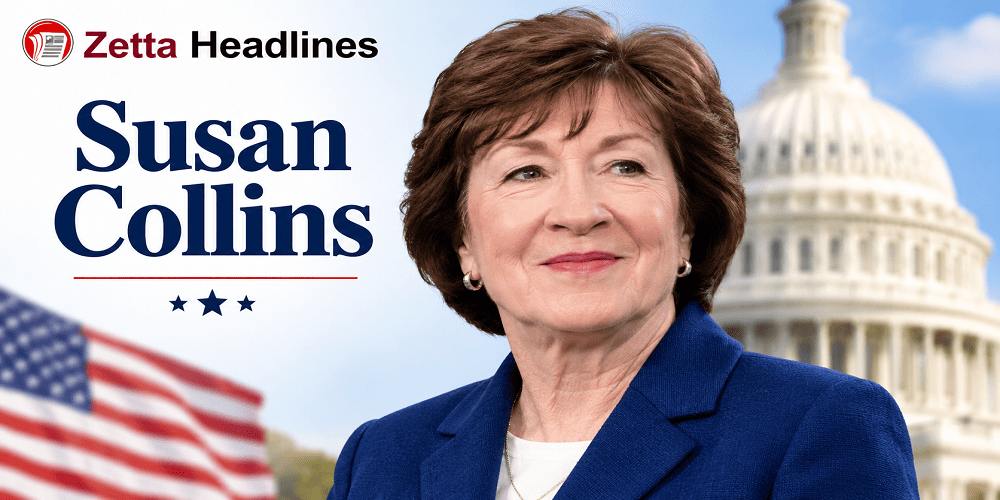
Susan Collins is a well-known American politician who has represented the state of Maine in the United States Senate since 1997. Over the course of her long political career, she has developed a reputation for taking independent positions on major national issues, sometimes breaking with members of her own Republican Party.
Her political style has made her one of the more closely watched senators in Washington. Supporters often describe her as a moderate Republican who is willing to work across party lines, while critics argue that some of her votes have still aligned closely with the broader Republican agenda.
Beyond individual votes, her career reflects many of the political changes that have taken place in the United States over the past three decades. She has worked on issues involving healthcare, national security, government spending, education, small businesses, and the economy.
This article looks at Susan Collins's background, political career, major positions, Senate work, and why she continues to attract national attention.
Who Is Susan Collins?
Susan Collins is a Republican senator from Maine. She was first elected to the U.S. Senate in 1996 and began serving in January 1997. She has subsequently won reelection several times, establishing herself as one of the longest-serving members of Maine's congressional delegation.
Unlike politicians who strongly identify with one ideological wing of their party, Collins has often presented herself as a centrist or moderate Republican. She has occasionally supported legislation backed by Democrats and has also voted with Republicans on important issues.
Her approach has been particularly noticeable during periods when the Senate has been closely divided between Republicans and Democrats. In such situations, a small number of moderate senators can have significant influence over whether legislation passes.
Susan Collins has therefore frequently been involved in high-profile negotiations and votes.
Early Life and Education
Susan Margaret Collins was born on December 7, 1952, in Caribou, Maine. She grew up in a family with a strong connection to public service and politics.
Her father, Donald Collins, was involved in local government and served as mayor of Caribou. Her mother, Patricia, was also active in the community. Growing up in northern Maine gave Collins an early understanding of local government and the concerns of people living outside major metropolitan areas.
She attended Caribou High School before continuing her education at St. Lawrence University in Canton, New York. She graduated in 1975 with a bachelor's degree in government.
Her educational background helped prepare her for a career focused on public policy and government.
Susan Collins's Early Political Career
Before entering the U.S. Senate, Collins worked in government and politics at both the state and federal levels.
One important part of her early career was her work for Senator William Cohen, another Republican from Maine. Cohen later became Secretary of Defense during the Clinton administration.
Working with Cohen provided Collins with valuable experience in federal policymaking and gave her an opportunity to understand how Congress and the executive branch operate.
She later served as commissioner of professional and financial regulation in Maine.
In 1994, Collins ran for governor of Maine. She won the Republican nomination but lost the general election to independent candidate Angus King.
Although the gubernatorial campaign did not result in victory, it helped increase her visibility in Maine politics.
Two years later, she successfully ran for the U.S. Senate.
Election to the U.S. Senate
Susan Collins was elected to the Senate in 1996. Her victory began a congressional career that would last for decades.
At the time, Maine was politically distinctive. Although Republicans had traditionally been competitive in the state, Maine voters also had a strong history of supporting independent and moderate candidates.
Collins built her political identity around that environment.
She emphasized bipartisan cooperation and presented herself as someone who could work with politicians from both parties.
Over the years, she became particularly important during closely divided Senate sessions because her vote could sometimes determine whether a bill or nomination succeeded.
Susan Collins and the Republican Party
Susan Collins identifies as a Republican, but her voting record has sometimes differed from the positions taken by Republican leaders.
This has made her both influential and controversial.
Her moderate reputation became especially prominent during the presidency of Donald Trump. Collins supported some Republican policies while publicly criticizing or opposing the administration on other matters.
One of the most notable examples came during the debate over healthcare legislation.
In 2017, Collins voted against the Republican effort to repeal and replace the Affordable Care Act. Her decision contributed to the failure of the legislation.
She argued that healthcare policy should be approached carefully and that changes should not leave people without adequate coverage.
Her healthcare position helped reinforce her reputation as one of the Senate's more independent Republicans.
Susan Collins and Healthcare
Healthcare has been an important issue throughout Collins's Senate career.
She has supported efforts to improve healthcare access while also expressing concerns about the cost of medical treatment and prescription drugs.
Her approach has generally focused on incremental changes rather than sweeping changes to the healthcare system.
She has also supported measures involving prescription drug prices, Medicare, rural healthcare, and healthcare services.
For Maine, rural healthcare is particularly important because many communities are located far from large hospitals and specialized medical facilities.
Collins has frequently emphasized the needs of rural communities when discussing healthcare legislation.
Susan Collins and Abortion Policy
Abortion is another issue on which Collins has sometimes taken a different position from many Republicans.
She has described herself as supportive of abortion rights in certain circumstances while also supporting some restrictions.
Her position has made her one of the more moderate Republicans on abortion policy.
The issue became even more politically significant following the U.S. Supreme Court's 2022 decision in Dobbs v. Jackson Women's Health Organization, which overturned the constitutional protection established by Roe v. Wade.
Collins expressed disappointment with the decision and has supported legislation designed to protect access to certain reproductive healthcare services.
Her stance has distinguished her from many conservative Republicans.
Susan Collins and the Supreme Court
Supreme Court nominations have been among the most closely watched votes of Collins's career.
She has supported several Republican nominees while also becoming involved in controversies surrounding the confirmation process.
In 2018, she voted to confirm Brett Kavanaugh to the Supreme Court. Her speech explaining the decision received significant national attention.
Collins argued that she believed Kavanaugh would respect the constitutional limits of the judiciary and would not overturn Roe v. Wade.
After the Dobbs decision in 2022, her position became the subject of renewed political debate.
This episode illustrates the complicated position Collins often occupies in American politics: she can support a Republican nominee while disagreeing with the consequences of later decisions.
Susan Collins and National Security
National security has been another major area of Collins's Senate work.
Her earlier experience working with William Cohen helped shape her interest in defense and national security issues.
She has supported strong national defense policies and has frequently emphasized the importance of America's relationships with its allies.
Collins has also been involved in discussions concerning NATO, Russia, Ukraine, terrorism, cybersecurity, and intelligence.
Her approach to foreign policy generally reflects traditional Republican views on national security, although she has also supported bipartisan initiatives.
Susan Collins and Ukraine
The war in Ukraine has been an important issue during Collins's recent Senate career.
She has strongly supported assistance for Ukraine and has argued that helping Ukraine resist Russian aggression is important for American and European security.
Collins has also emphasized the role of NATO allies and the importance of maintaining a united response to Russian military actions.
Her position has placed her firmly among the Republican senators who support continued U.S. assistance to Ukraine.
The issue has also become part of the larger debate within the Republican Party over America's role in international conflicts.
Susan Collins and the Economy
Economic issues are another major component of Collins's political work.
She has frequently focused on small businesses, workers, rural economies, infrastructure, and federal spending.
Maine has a large number of small businesses and rural communities, so policies affecting these areas are particularly important to the state's economy.
Collins has supported legislation intended to provide assistance to businesses and communities while also raising concerns about excessive federal spending.
Her economic positions often combine traditional Republican concerns about taxation and government spending with support for federal programs that benefit Maine residents.
Susan Collins and Bipartisanship
Bipartisanship is perhaps the defining feature of Susan Collins's political image.
She has worked with Democrats on legislation involving infrastructure, healthcare, government funding, veterans, national security, and other issues.
In the Senate, bipartisan cooperation can become especially important when neither party has a large majority.
Collins has sometimes played a negotiating role in these situations.
Her supporters argue that this makes her an effective senator because she is willing to compromise.
Critics, however, sometimes argue that her moderate image does not always match her overall voting record.
This disagreement is part of the broader debate about what it means to be a moderate politician in modern Washington.
Susan Collins's Committee Work
Over her Senate career, Collins has served on several important committees.
Her committee assignments have included areas such as homeland security, government affairs, health, education, labor, and appropriations.
Committee positions are important because much of Congress's detailed legislative work takes place through committees.
Through these roles, Collins has been involved in issues ranging from federal spending to healthcare and national security.
Her work on appropriations has also given her a significant role in determining how federal money is allocated.
Susan Collins and Maine
Although national politics often receives the most attention, representing Maine remains central to Collins's work.
Maine has a distinctive economy and geography. Its residents include farmers, fishermen, small business owners, healthcare workers, retirees, and people living in rural communities.
The state's aging population also makes issues such as Social Security, Medicare, healthcare, and prescription drug costs particularly important.
Collins frequently emphasizes the practical effects of federal policy on Maine residents.
She has also supported policies involving fisheries, agriculture, rural infrastructure, transportation, and local economic development.
Why Is Susan Collins So Influential?
Susan Collins's influence comes partly from her position within the Republican Party and partly from the Senate's political structure.
When Republicans have a narrow majority, a small number of Republican senators can become especially important.
If Democrats remain united against a Republican proposal, Republican leaders may need every Republican vote to pass legislation.
In those circumstances, senators such as Collins can have substantial negotiating power.
Her independent voting record can therefore make her an important figure even when she is not part of the party leadership.
Criticism of Susan Collins
Susan Collins has faced criticism from both sides of the political spectrum.
Progressives have criticized her for supporting Republican legislation and judicial nominees they consider too conservative.
Some conservatives, meanwhile, have criticized her for opposing Republican priorities or working with Democrats.
This unusual position means that Collins does not always fit neatly into one political category.
Her supporters view that independence as a strength.
Her critics sometimes see it as inconsistency.
The debate over her political identity is likely to continue as long as she remains an influential Senate vote.
Susan Collins's Political Legacy
After decades in Washington, Susan Collins has developed one of the longest political careers among current U.S. senators.
Her legacy will likely be associated with moderation, bipartisan negotiation, healthcare policy, national security, and her role in closely contested Senate votes.
She has also demonstrated that a Republican politician can maintain a strong political career in Maine by building an identity that differs from the national Republican mainstream on certain issues.
At the same time, her career shows how difficult it can be to maintain a moderate political identity in an increasingly polarized political environment.
What Makes Susan Collins Different?
The biggest difference between Collins and many other national politicians is her emphasis on independence.
She does not always vote according to the position of Republican leadership, and she has regularly emphasized the importance of compromise.
However, independence does not mean that she rejects her party's principles entirely.
She remains a Republican and has supported many Republican priorities.
Her political identity is therefore better understood as a combination of Republican affiliation, moderate positions on selected social issues, and a willingness to negotiate across party lines.
Susan Collins's Continuing Role in American Politics
Susan Collins remains an important figure in the U.S. Senate because of her experience and her ability to influence close votes.
As American politics becomes more polarized, senators who can attract bipartisan support can play a significant role in negotiations.
At the same time, the pressure on moderate politicians has increased. Voters and political activists increasingly expect elected officials to take clear positions on controversial issues.
For Collins, balancing her Maine-centered political identity with the national Republican Party will continue to be an important part of her career.
Her long tenure also means that she has witnessed major changes in American politics, from the late 1990s through the political divisions of the 2020s.
Final Thoughts
Susan Collins has built a remarkable political career based on experience, independence, and a reputation for bipartisan cooperation.
From her early years in Maine politics to her decades in the U.S. Senate, she has remained an important voice in discussions about healthcare, national security, the economy, reproductive rights, federal spending, and foreign policy.
Her voting record has sometimes pleased Republicans, sometimes frustrated them, and at other times attracted support from Democrats.
That complexity is a major part of her political identity.
Whether people agree with her decisions or not, Susan Collins has demonstrated how influential a senator can become by occupying a pivotal position within a closely divided Senate.
Her career also provides an interesting look at the changing nature of American politics and the challenges faced by politicians who attempt to maintain an independent identity in a highly partisan environment.
FAQs About Susan Collins
1. Who is Susan Collins?
Susan Collins is a Republican politician who has represented Maine in the U.S. Senate since 1997. She is known for her moderate political positions and willingness to work with members of both parties.
2. How long has Susan Collins been a senator?
Susan Collins began serving in the U.S. Senate in January 1997. She has been reelected multiple times and has become one of the longest-serving senators from Maine.
3. Is Susan Collins a Republican?
Yes. Susan Collins is a member of the Republican Party. However, she has developed a reputation as a moderate Republican and has occasionally disagreed with Republican leadership on major issues.
4. What issues is Susan Collins known for?
Susan Collins is particularly known for her work involving healthcare, national security, federal spending, rural communities, reproductive rights, small businesses, and bipartisan legislation.
5. Why is Susan Collins considered a moderate Republican?
She is considered moderate because she has sometimes supported policies or legislation that differ from the positions of conservative Republicans. She has also voted with Democrats on certain high-profile issues and has emphasized bipartisan cooperation throughout her Senate career.
Leave A Comment
0 Comment