
You know that foggy feeling after sitting at a desk for six hours straight? Or the way your head seems heavier when you have not moved much all day? It turns out there might be a real biological reason for that. A team of researchers over at Pennsylvania State University just published something that changes how we think about everyday movement and brain health. The penn state brain cleaning study, which came out in April 2026 in Nature Neuroscience, shows that simple actions like standing up, walking to the kitchen, or even just tightening your stomach muscles can actually help flush waste out of your brain. That is right. Your brain has a cleaning system, and moving your body is what turns it on.
Before we dig into the details, let me say this plainly. Most people assume that brain health is about eating right, sleeping enough, and maybe doing crossword puzzles. But the penn state brain cleaning study throws a new variable into the mix. It suggests that the mechanical act of moving your body, specifically your abdominal muscles, creates a kind of hydraulic pump that physically shifts your brain inside your skull. That shifting then pushes cleaning fluid through your brain tissue. It is weird to think about, honestly. Your brain sloshing around a little bit every time you take a step. But that sloshing, according to the research, might be exactly what keeps toxic gunk from building up.
So who figured this out? The lead researcher is a guy named Patrick Drew. He holds several titles at Penn State, including professorships in engineering, neurosurgery, biology, and biomedical engineering. You can tell he does not stay in one lane. He worked with another researcher named Francesco Costanzo, plus a handful of postdocs and grad students. They started with a simple question that somehow nobody had asked quite this way before. Why does physical exercise protect against Alzheimer's and other forms of dementia? We have known for decades that active people stay sharper longer. But the why part was always fuzzy. People pointed to better blood flow or reduced inflammation, and those things matter. But the penn state brain cleaning study found something more direct. Something almost physical.
Here is what they did. They used two-photon microscopy, which is a fancy way of saying they could watch living brains in action. They also used microcomputed tomography to look at entire brain structures in three dimensions. The subjects were mice, trained to walk on tiny treadmills while their heads stayed perfectly still. This setup let the researchers see exactly what happened inside the skull when the mice moved. And what they saw surprised them. The brain did not just sit there motionless while the body moved. Instead, every time the mouse contracted its abdominal muscles, which happens right before each step, the brain shifted position inside the skull. Not by a lot. Just a little. But enough.
Here is the part that really got the researchers excited. They wanted to know whether the leg movements themselves caused the brain shift, or whether something else was going on. So they tried an experiment. They applied gentle pressure to the abdomens of lightly anesthetized mice. No leg movement. No running. Just a little pressure, less than what you feel during a blood pressure test. And guess what? The brains shifted exactly the same way. That confirmed it. The abdominal muscles alone, without any other movement, could make the brain move. Drew said afterward that the brain returned to its normal position as soon as they released the pressure. So you have this cycle. Contract, shift. Release, return. Each time, something flows.
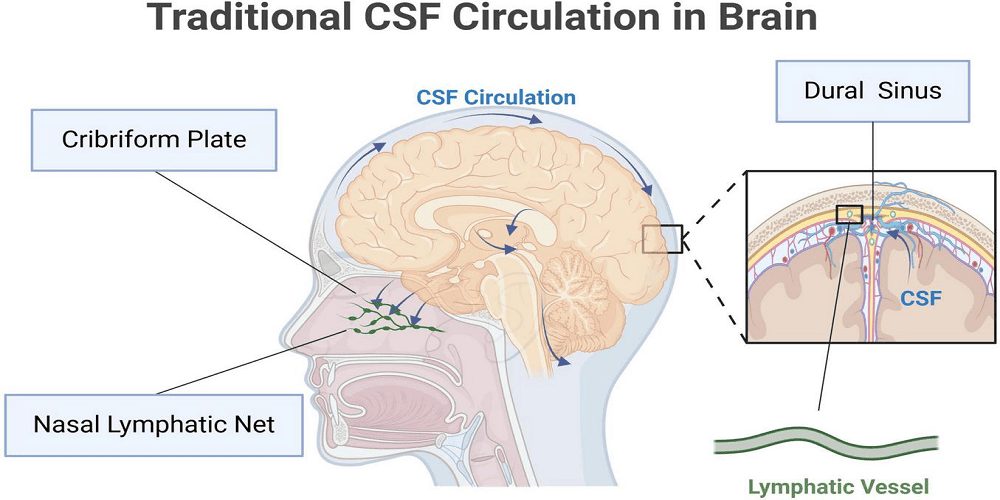
What flows is cerebrospinal fluid. That is the clear liquid that bathes your brain and spinal cord. Think of it as the brain cleaning solution. Unlike the rest of your body, which has a dedicated lymphatic system with vessels and nodes to filter out garbage, the brain has to rely on this fluid moving through its tight spaces. And when the fluid moves, it carries away metabolic waste. Things like beta-amyloid and tau proteins. You have probably heard those names before. They are the stuff that clumps together into the plaques and tangles seen in Alzheimer's disease. So if the cerebrospinal fluid does not move enough, those proteins stick around. They accumulate. Over years, that accumulation becomes pathology.
But here is the clever part of the penn state brain cleaning study. The researchers realized that brain motion alone does not mean fluid is actually moving through the tissue. So they built computer simulations to test the physics. Costanzo led that effort. He described the brain as being a lot like a sponge. Imagine you have a dirty sponge sitting under a slowly dripping faucet. The water runs over it, but does it get clean? Not really. The dirt is trapped in the pores. You have to squeeze the sponge to push the water through the pores and flush the dirt out. That is what the brain needs. It needs the passive flow of cerebrospinal fluid, but it also needs the squeeze. And the squeeze comes from movement. From those little shifts inside the skull. The simulations confirmed that the gentle brain motion caused by abdominal contractions produces exactly the kind of fluid displacement required to push waste out of the brain tissue and into the spaces where it can be eliminated.
One thing I really appreciate about the penn state brain cleaning study is how low the bar turns out to be. You do not need to run marathons. You do not need to do CrossFit. You do not even need to break a sweat. The abdominal contractions that matter happen during virtually any physical behavior. Standing up from a chair? You brace your core. That counts. Walking to the bathroom? That counts. Vacuuming the living room? Gardening? Climbing stairs? All of it counts. This is huge news for older adults or anyone with mobility limitations. The research suggests that frequent, low-intensity movement throughout the day provides cumulative benefits. It is not about one hard workout. It is about breaking up sedentary time. The hydraulic pump responds to repeated contractions, not to peak intensity.
Now let me connect this to something you already know about sleep. There has been other research from Penn State, separate from this study, showing that sleep quality predicts cognitive performance. A January 2026 study in Sleep Health found that older adults who woke up frequently during the night did worse on cognitive tests the next day. Not just total sleep time, but continuity. Waking up over and over messed with their processing speed and visual working memory. That matters because we already knew that during deep sleep, cerebrospinal fluid flows into the brain from the subarachnoid space. That flow is driven by arterial pulsing. The penn state brain cleaning study adds a second shift. Movement cleans during the day. Sleep cleans at night. If you sit still all day and also sleep poorly, you are really asking for trouble. But if you move often and sleep well, you are giving your brain two different cleaning crews working around the clock.
I should mention that the study has limitations, because every good study does. The experiments were done in mice. Mice are mammals, and their basic physiology looks a lot like ours. But their brains are smaller, their skulls are different, and their cerebrospinal fluid dynamics might not match ours exactly. Drew himself said more work is needed to fully confirm the findings in humans. That said, the mechanical principle is pretty universal. Abdominal contractions create pressure waves. Those waves travel through the venous system. That system connects to the spine. The spine connects to the skull. So it would be more surprising if the same thing did not happen in people. The research team is probably planning human studies right now, using functional MRI or other imaging to watch brain motion during movement.
Another limitation is that the penn state brain cleaning study did not directly measure waste clearance rates. The simulations strongly suggest that brain motion drives fluid flow, but direct measurement of beta-amyloid or tau clearance during movement remains a goal for future research. You cannot just crack open someone skull after a walk and measure the protein levels. Well, you could, but that would be unethical. So researchers have to rely on indirect methods and animal models for now. That does not make the finding less real. It just means we need to be patient while science catches up.
Let me share a few examples of how this research might change everyday life. Imagine workplace design. Most office jobs keep people seated for hours. The penn state brain cleaning study suggests that standing desks, walking meetings, and regular reminders to stand up might actually contribute to brain health, not just physical health. Imagine rehabilitation protocols. Physical therapists working with stroke patients or traumatic brain injury patients already try to get people moving as soon as possible. Now they have another reason. Movement might directly aid neural recovery by enhancing waste clearance from damaged brain tissue. Imagine education. Kids who are forced to sit still all day might not be doing their brains any favors. Recess, movement breaks, even fidgeting could serve a biological purpose.
There is also a darker implication to consider. Sedentary lifestyles are becoming the norm. People sit at computers, then sit in cars, then sit on couches watching screens. The penn state brain cleaning study provides a mechanistic explanation for why that lifestyle correlates with cognitive decline. It is not just that you lose muscle mass or gain weight. It is that your brain cleaning system runs less frequently. Waste accumulates faster than it can be removed. Over years, that accumulation could push you over the threshold into dementia. That is a scary thought, but it is also empowering. Because the solution is simple. Move more. Not necessarily harder. Just more often.
The sponge analogy from Costanzo really sticks with me. A dirty sponge under a running faucet does not get clean unless you squeeze it. Your brain has fluid running through it all the time, thanks to your heartbeat and your breathing. But without the squeeze from movement, that fluid might just sit there. Or flow around the outside without penetrating the deep pores. The squeeze pushes the fluid into the tight spaces between cells. It flushes out the garbage that has been sitting there since your last walk or your last night of deep sleep. So every time you stand up, you are squeezing your brain sponge a little bit. Every time you tighten your core to climb a step, you are helping your brain take out the trash.
I want to circle back to something I mentioned earlier. The connection between the penn state brain cleaning study and sleep research is really elegant. During sleep, cerebrospinal fluid flows from the outside of the brain inward. During waking movement, it flows from the inside outward. They work in opposite directions. That means if you only sleep well but never move, you might push fluid into the brain but not have the mechanical squeeze to push it back out with the waste. If you only move but sleep poorly, you might squeeze the sponge but not have enough fluid available to do the flushing. You need both. You need the fluid and the squeeze. The night shift and the day shift. That is probably why both physical activity and sleep quality independently predict cognitive outcomes in aging populations. They are not redundant. They are partners.
Where does this research go from here? I would bet money that follow-up studies will look at exactly how much movement is optimal. Is there a minimum number of abdominal contractions per day? Does the timing matter? Are some movements better than others? The penn state brain cleaning study did not answer those questions. It opened the door. It showed the mechanism exists. Now other researchers will try to quantify it. Some might look at whether people with back injuries or abdominal surgery have different rates of cognitive decline, since their abdominal muscle function might be compromised. Others might design interventions for sedentary office workers to see if frequent movement breaks improve cognitive test scores over time.
In the end, what strikes me most about the penn state brain cleaning study is how it changes the meaning of ordinary actions. You wake up. You get out of bed. You walk to the bathroom. You stand in the kitchen while your coffee brews. You climb the stairs to your office. None of those things feel like exercise. They are just life. But according to this research, every single one of those movements triggers a tiny hydraulic pump that helps clean your brain. That is pretty amazing when you think about it. Your body already knows how to maintain itself. You just have to keep using it. Do not let yourself get too still for too long. Get up. Walk around. Tighten your stomach when you stand. Your brain will thank you later.
Frequently Asked Questions
Q1: What exactly did the penn state brain cleaning study discover?
The study discovered that contracting your abdominal muscles pushes blood from your abdomen into a network of veins around your spine. That pressure wave travels upward and gently moves your brain inside your skull. The motion drives cerebrospinal fluid through brain tissue, flushing out metabolic waste like beta-amyloid and tau proteins.
Q2: Who ran the penn state brain cleaning study?
Patrick Drew from Penn State led the research, working with Francesco Costanzo and a team of postdoctoral researchers and graduate students. Drew holds appointments in engineering, neurosurgery, biology, and biomedical engineering. The study published in Nature Neuroscience in April 2026.
Q3: Were the experiments done on humans or animals?
The experiments used mice. The researchers acknowledge that more work is needed to confirm the findings in humans, but the basic mechanical principles should translate because mice are mammals with similar physiology. Human studies are likely coming next.
Q4: How is the penn state brain cleaning study different from sleep research?
Sleep research shows that brain cleaning happens during deep sleep, with cerebrospinal fluid flowing into the brain from the outside. The penn state brain cleaning study shows that movement cleans during wakefulness, with fluid flowing outward. Sleep and movement work as complementary shifts.
Q5: Do I need to exercise hard to get the benefit?
No. The study found that even small abdominal contractions work. Standing up, walking, climbing stairs, vacuuming, gardening, or any activity that engages your core muscles triggers the effect. The pressure required is less than a blood pressure test. Frequent low-intensity movement matters more than occasional intense workouts.
Q6: What waste products does the penn state brain cleaning study focus on?
The research focuses on beta-amyloid and tau proteins. These proteins accumulate during normal neural activity. When they are not cleared properly, they form plaques and tangles associated with Alzheimer disease and other neurodegenerative conditions.
Q7: Does the penn state brain cleaning study apply to people with mobility issues?
Yes, the findings are encouraging for people with limited mobility. Any movement that engages the abdominal muscles, including transfers, wheelchair pushes, or seated exercises that involve core bracing, likely produces some benefit. Even small amounts of movement help.
Q8: How did the researchers measure brain motion?
They used two-photon microscopy to watch living brain tissue in mice and microcomputed tomography to examine whole brains in three dimensions. They also used anesthetized mice to apply isolated abdominal pressure without leg movement, confirming that abdominal muscles alone cause brain shift.
Q9: What is the sponge analogy from the penn state brain cleaning study?
Francesco Costanzo compared the brain to a dirty sponge. Running water over a sponge does not clean it because the dirt is trapped in the pores. You have to squeeze the sponge to push water through the pores. The brain needs both fluid flow and mechanical compression from movement.
Q10: What should I do differently based on the penn state brain cleaning study?
Break up long periods of sitting. Stand up frequently. Walk around whenever possible. Engage your core when you stand. Do not rely on one daily workout to compensate for hours of stillness. Movement throughout the day, even small movements, helps your brain clean itself. And do not neglect sleep. You need both.
Leave A Comment
0 Comment