
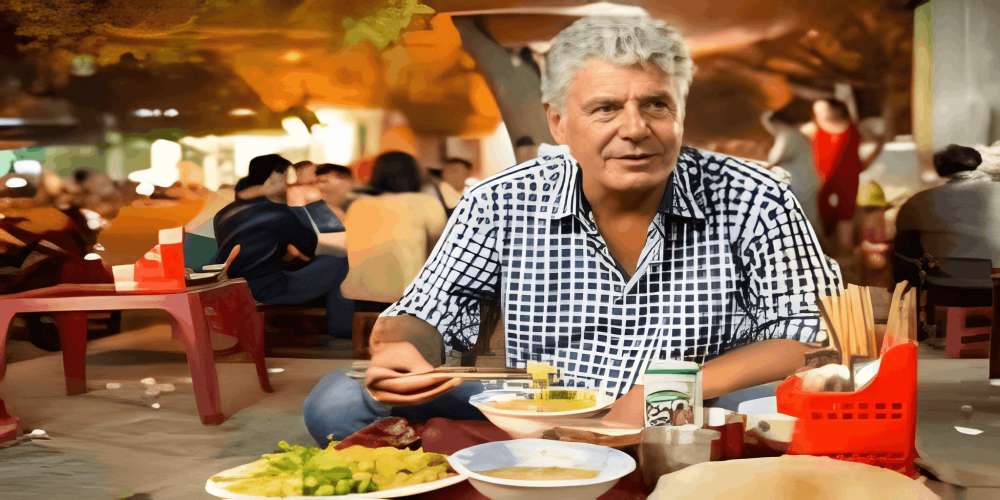
Anthony Bourdain was never supposed to become a household name. He spent the better part of his twenties and thirties as a line cook and later as an executive chef in New York City, buried in the chaos of restaurant kitchens, writing fiction that no one read. Then, in 1999, The New Yorker published his essay “Don’t Eat Before Reading This,” a raw, unflinching look behind the kitchen doors. That piece became the foundation for his 2000 bestselling book Kitchen Confidential. From that moment, Anthony Bourdain transformed from a talented but frustrated chef into one of the most influential voices in food, travel, and cultural commentary. His legacy remains complex, powerful, and deeply personal to millions who saw in him not just a television host, but a searcher.
The rise of Anthony Bourdain was not an accident of luck. He wrote with a voice that was cynical yet vulnerable, tough yet tender. He understood that food was never just about sustenance. For Anthony Bourdain, a bowl of noodles in a Vietnamese market or a grilled meat skewer in a Lebanese street stall carried the weight of history, politics, family, and survival. He used food as a passport, but never as a filter. Where other travel hosts showed postcard-perfect landscapes, Anthony Bourdain showed messy realities. He ate with rebels in Iran, with dockworkers in Scotland, with grandmothers in Georgia. He did not pretend to be neutral. He was angry about inequality, frustrated by American foreign policy, and openly contemptuous of pretentious cooking trends that ignored human dignity.
The television career of Anthony Bourdain began with A Cook’s Tour in 2002, but it was No Reservations on the Travel Channel and later Parts Unknown on CNN that cemented his style. Parts Unknown, which ran for twelve seasons, won multiple Emmy Awards. But awards were never the point. What made Anthony Bourdain different was his refusal to perform happiness. He struggled with depression, addiction, and a deep sense of restlessness. He talked about these struggles openly, sometimes on camera, sometimes in his books. This honesty made him feel like a friend to viewers. When Anthony Bourdain described the loneliness of constant travel or the exhaustion of being the person everyone expects to be adventurous and wise, people listened because they recognized their own hidden sadness.
Anthony Bourdain wrote more than ten books, including cookbooks, biographies of Typhoid Mary, and graphic novels. He also wrote a collection of essays titled Medium Raw, which served as a follow-up to Kitchen Confidential. In that book, Anthony Bourdain revisited old grudges and also offered unexpected forgiveness. He wrote about his daughter, about finding peace in fatherhood, about the possibility that a man who spent decades running from stability could finally sit still. That vulnerability is why discussions around Anthony Bourdain remain so active years after his death in June 2018. He died by suicide in France, where he was filming an episode of Parts Unknown. The shock was immense because Anthony Bourdain appeared to have everything—success, love, respect, adventure. His death forced many conversations about mental health, particularly among men in high-pressure creative fields.
What makes Anthony Bourdain a lasting figure is not just his television shows or his books. It is his philosophy. He believed that the best way to understand a culture was not through museums or monuments, but through its markets, its home kitchens, its street vendors. He said often that food was the only universal language. When Anthony Bourdain sat down with a family in Vietnam who had fought against Americans during the war, he did not erase history. He acknowledged it, then broke bread anyway. That act of shared humanity became his signature. He showed that empathy does not require agreement. It only requires presence.
The influence of Anthony Bourdain can be seen across modern food media. Countless travel and food shows today mimic his format: the host walks through a market, talks to locals, eats something unusual, and reflects on life. But most lack his edge. Anthony Bourdain had a writer’s discipline. Every narration, every voiceover was crafted. He read poetry constantly, particularly the work of Charles Bukowski and Pablo Neruda. He listened to punk rock and old jazz. His cultural references were wide and unexpected. When Anthony Bourdain described a meal, he might compare it to a Velvet Underground song or a scene from a French New Wave film. He was not a chef performing for the camera. He was a writer who happened to cook for a living.
For young chefs and travelers, Anthony Bourdain remains a north star. He proved that you could be successful without being cruel. He proved that you could be masculine and still cry on camera. He proved that intellectual curiosity and street smarts could coexist. Many chefs cite Anthony Bourdain as the reason they entered the industry. Others credit him for leaving toxic kitchens. His criticism of chef culture—the shouting, the abuse, the drug use—was sharp because he had lived it. When Anthony Bourdain spoke against sexual harassment in restaurants or called out famous chefs for abusive behavior, he risked his own standing in a small, insular world. He did it anyway.
The business legacy of Anthony Bourdain is also worth examining. He turned his personal brand into a multiplatform empire without losing his soul. He had production companies, book deals, speaking tours, and merchandise. Yet he never felt corporate. That balance is rare. Anthony Bourdain managed to be commercially successful while maintaining artistic integrity because he never pretended to be something he was not. He loved expensive whiskey and also loved cheap beer. He dined at three-Michelin-star temples and also celebrated gas station tacos. That range made him accessible to both fine dining enthusiasts and everyday eaters.
Fans of Anthony Bourdain often rewatch his episodes as comfort viewing. There is a ritual around it. You watch him walk through a crowded Hanoi market, wiping sweat from his forehead, laughing with a vendor who does not speak English. You watch him eat something unfamiliar, close his eyes, nod slowly. Then Anthony Bourdain looks at the camera and says something like, “This is why I keep doing this. Not for the money. Not for the fame. For this exact moment.” Those moments feel sacred precisely because he knew they would end. He was always aware of mortality. In his later years, Anthony Bourdain spoke often about time running out. That awareness made him cherish small pleasures more intensely.
The death of Anthony Bourdain left a void that has not been filled. Many have tried to replicate his shows. Some are good. None have his combination of poetry and punk attitude. Part of the reason is that Anthony Bourdain was not playing a character. He was genuinely uncomfortable with praise. He was genuinely angry about injustice. He was genuinely tender toward his daughter and his closest friends. When he praised a dish, you believed him. When he criticized a trend, you trusted his judgment. That trust took years to build and cannot be manufactured quickly.
Anthony Bourdain also used his platform to elevate voices that were ignored by mainstream media. He traveled to Liberia during the Ebola crisis, not to gawk, but to show how people lived and ate amid fear. He went to the West Bank and sat with Palestinian families under occupation. He went to Detroit when the city was dismissed as dead and showed its vibrant food scene. In every case, Anthony Bourdain refused to reduce people to statistics or stereotypes. He looked into their eyes, asked real questions, and listened. That is why journalists and documentarians still study his work. He was a master of the long-form, slow-paced, human-centered story.
The writing style of Anthony Bourdain is taught in some creative nonfiction courses. His sentences are direct but not simple. He uses short punches: “The pork was fatty. The beer was cold. The afternoon was hot and stupid.” Then he builds a longer, reflective paragraph about war and memory. He shifts tone effortlessly. He can be hilarious for three pages, then devastating on page four. That range keeps readers engaged. When you read Anthony Bourdain, you feel like you are sitting next to him at a bar, half-drunk, listening to stories that might be exaggerated but feel absolutely true.
Critics of Anthony Bourdain sometimes argued that he romanticized poverty or that his cynicism became a performance. These critiques are worth considering. No public figure is above examination. However, even critics acknowledge that Anthony Bourdain was more self-aware than most. He admitted his own contradictions. He admitted that he sometimes exploited the suffering of others for television. He did not claim purity. He claimed curiosity. For most fans, that honesty is enough. In a media landscape filled with polished, focus-grouped personalities, Anthony Bourdain felt like a real person who happened to have a camera crew following him.
The influence of Anthony Bourdain extends to food policy and social justice. He spoke out against the celebrity chef culture that normalized sexual harassment in kitchens. He supported fair wages for restaurant workers. He criticized the environmental cost of luxury ingredients like bluefin tuna. He used his voice to advocate for immigrant food vendors who face legal persecution. These were not side issues for Anthony Bourdain. They were central to his understanding of food. You cannot love food, he argued, without loving the people who make it and serve it. And you cannot love those people without fighting for their rights.
Memorials for Anthony Bourdain continue to appear around the world. Fans leave bowls of noodles outside the Hanoi restaurant where he once ate with President Barack Obama. That episode remains one of the most famous of Parts Unknown. Anthony Bourdain and Obama sat on plastic stools, ate bun cha, and talked about fatherhood, leadership, and regret. It was not an interview. It was a conversation between two people who understood public pressure and private doubt. After Anthony Bourdain died, Obama released a statement calling him a man who “taught us about food but also about courage and vulnerability.” That combination is rare.
For those who discovered Anthony Bourdain after his death, his work remains fully alive. His books are still in print. His shows are still streamed. His voiceovers live on YouTube. Young people who were children when Anthony Bourdain died now watch his episodes and feel a strange nostalgia for a person they never met. That is the mark of a true artist. You do not have to be alive to continue teaching, comforting, and provoking. Anthony Bourdain once wrote, “I should have died in my thirties.” He did not. He lived two more decades, gave the world a body of work, and left when the pain became too great. The tragedy is not that he died. The tragedy is that he suffered so much while giving so many people joy.
The legacy of Anthony Bourdain is not just his body of work but the conversations he started. He made it acceptable to talk about mental health in the restaurant industry. He made it acceptable to question authority, whether that authority was a famous chef or a television network. He made it acceptable to change your mind. Anthony Bourdain once hated vegetarians. Later, he apologized and admitted they were right about many things. He once refused to eat at certain kinds of restaurants. Later, he said he had been a snob. Watching Anthony Bourdain evolve was part of the pleasure of following his career.
In the end, Anthony Bourdain was a storyteller who used food as his medium. But the stories were never really about food. They were about loneliness, connection, loss, and the small redemptive pleasures of a hot meal shared with a stranger. When you watch him eat with a family in Myanmar or share tea with nomads in Mongolia, you are not watching a travel show. You are watching a meditation on what it means to be human. Anthony Bourdain understood that humans are fragile, messy, and beautiful. He did not try to hide his own fragility. That is why, years after his death, we still talk about Anthony Bourdain. We still learn from Anthony Bourdain. We still miss Anthony Bourdain.
Short FAQs on Anthony Bourdain
Q1: What made Anthony Bourdain different from other food television hosts?
Anthony Bourdain focused on cultural storytelling rather than pure food critique. He traveled to politically complex regions, engaged with local people honestly, and never hid his own struggles with depression and addiction. His narration had a literary quality that other hosts rarely matched.
Q2: Which Anthony Bourdain book should I read first?
Start with Kitchen Confidential. It is his breakthrough work and gives you the raw, funny, angry voice that defined his career. After that, read Medium Raw, which revisits earlier topics with more maturity and reflection.
Q3: Did Anthony Bourdain have formal culinary training?
Yes. He graduated from The Culinary Institute of America in 1978. He worked in various New York City restaurants for decades, eventually becoming executive chef at Brasserie Les Halles in Manhattan.
Q4: How did Anthony Bourdain die?
He died by suicide in June 2018 in Kaysersberg, France, while filming an episode of Parts Unknown. He was 61 years old. His death sparked widespread conversations about mental health support in the restaurant and entertainment industries.
Q5: What is the best Anthony Bourdain television episode to watch for a first-time viewer?
Many fans recommend the Parts Unknown episode set in Hanoi, Vietnam, where Anthony Bourdain eats with President Barack Obama. It captures his warmth, curiosity, and ability to find common ground across vast differences.
Q6: Did Anthony Bourdain win any major awards for his work?
Yes. Parts Unknown won multiple Primetime Emmy Awards for Outstanding Writing for a Nonfiction Programming and Outstanding Informational Series or Special. He also won Peabody Awards for his honest, culturally sensitive travel journalism.
Q7: What was Anthony Bourdain’s attitude toward vegetarianism and veganism?
Early in his career, he mocked vegetarians openly. Later, he apologized and acknowledged the environmental and ethical arguments for plant-based eating. He never became vegetarian himself but stopped criticizing those who chose that lifestyle.
Q8: How did Anthony Bourdain influence modern restaurant culture?
He exposed the dark side of professional kitchens including substance abuse, verbal abuse, and low wages. He also championed fair treatment of immigrant kitchen workers and spoke out against celebrity chefs who abused their power.
Q9: Are there any documentary films about Anthony Bourdain?
Yes. Roadrunner: A Film About Anthony Bourdain directed by Morgan Neville was released in 2021. It includes unreleased footage and interviews with his closest friends and family. The film does not shy away from the difficult aspects of his life and death.
Q10: What is the best way to honor Anthony Bourdain’s legacy today?
Travel with curiosity, not judgment. Eat at local family-run restaurants. Tip generously. Listen to people whose lives are different from yours. Be honest about your own struggles. And never stop asking questions about where your food comes from and who made it possible.
Leave A Comment
0 Comment