
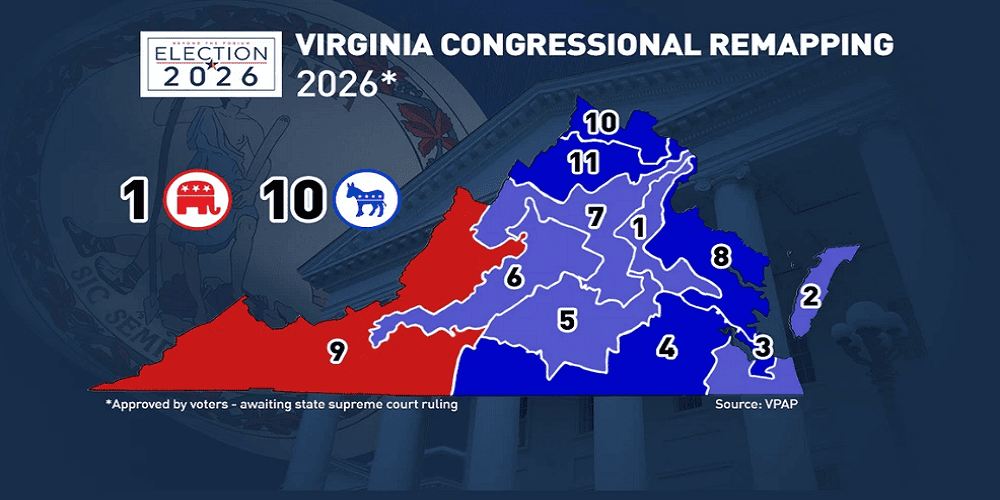
In every election cycle, few states receive as much analytical attention as Virginia. Once considered reliably Republican in presidential contests, the Commonwealth has transformed into a battleground where demographic shifts, suburban realignment, and legislative redistricting constantly reshape political power. At the heart of this transformation lies what strategists call the Virginia Democrats election map appeal. This phrase refers not merely to a legal objection or a single court filing but to a broader strategic effort by Democratic operatives, lawmakers, and activists to redraw, challenge, or leverage Virginia’s electoral districts in ways that favor their candidates. To understand the Virginia Democrats election map appeal, one must first appreciate how maps are drawn in Virginia, who controls the process, and why appeals—both to courts and to public opinion—have become central to Democratic strategy.
The concept of a map appeal can be confusing to voters who rarely think about district boundaries except when they see strangely shaped polygons on a news graphic. But for Democrats in Virginia, the appeal has multiple layers. First, there is the literal legal appeal: when a redistricting plan is struck down by a lower court, the losing party appeals to a higher court. Second, there is the rhetorical appeal: Democrats argue to the public that a given map is unfair, unrepresentative, or racially gerrymandered. Third, there is the strategic appeal to the Virginia Redistricting Commission, a bipartisan body created by a 2020 constitutional amendment. Understanding all three dimensions is necessary to grasp why the Virginia Democrats election map appeal remains a live issue heading into the next election.
The Historical Context of Redistricting in Virginia
For most of the late twentieth century, Virginia was a solidly red state in presidential elections. Republicans controlled the governorship and both legislative chambers for extended periods. During that era, the Virginia Democrats election map appeal was almost nonexistent because Democrats rarely held enough power to challenge maps successfully. Instead, Republican majorities drew districts that protected incumbents and diluted Democratic votes, particularly in fast-growing northern Virginia suburbs. This changed after 2017, when Democrats made sweeping gains in the House of Delegates, fueled by resistance to Republican policies and demographic changes in places like Prince William and Loudoun counties.
The turning point came with a series of court rulings. Federal courts found that Virginia had unlawfully packed African American voters into a small number of districts, violating the Voting Rights Act. In response, a special master redrew the state’s legislative maps in 2018, creating more competitive districts. That intervention demonstrated that the Virginia Democrats election map appeal could succeed not only through political leverage but through litigation. Democrats learned that even when out of power, they could appeal to federal judges to enforce fair representation. This judicial avenue became a blueprint for future efforts.
The 2020 Constitutional Amendment and the Bipartisan Commission
In 2020, Virginia voters approved a constitutional amendment that created a new redistricting process. The amendment established a sixteen-member Virginia Redistricting Commission, composed of eight legislators and eight citizens. The goal was to remove partisan gerrymandering from the legislature’s hands. However, the commission quickly became a source of gridlock. In 2021, the commission failed to agree on maps for either Congress or the state legislature. As a result, the Supreme Court of Virginia took over the process and appointed special masters to draw the lines.
This breakdown is where the modern Virginia Democrats election map appeal gained urgency. Democrats argued that the special masters’ maps, while purportedly neutral, still tilted toward Republican interests in some regions, particularly in the western part of the state and in certain Senate districts. Democrats filed objections, but the court-approved maps stood. However, the failure of the commission also set the stage for future appeals. Democrats now argue that the constitutional amendment requires another look because the process did not achieve its stated goal of nonpartisan fairness. For many Democratic activists, the Virginia Democrats election map appeal is not just about individual districts but about restoring faith in a broken system.
Elements of the Democratic Appeal to Voters
Beyond courtrooms, the Virginia Democrats election map appeal operates in the public sphere. Democratic candidates and advocacy groups have launched campaigns to educate voters about how district lines affect everything from school funding to healthcare access. The core argument is simple: when maps are drawn unfairly, your vote carries less weight. This message resonates strongly in densely populated areas like Fairfax County, Arlington, and Alexandria, where Democratic votes are often concentrated into a small number of districts, a practice known as packing. By appealing directly to voters, Democrats hope to build pressure on Republican legislators to accept more competitive maps or to support a constitutional amendment that would switch to an independent, nonpartisan redistricting model similar to those in states like Michigan or Colorado.
One specific element of the Virginia Democrats election map appeal focuses on the 2024 House of Representatives map. Virginia has eleven congressional districts. Currently, Democrats hold six and Republicans hold five, but that narrow margin is deceptive. Several districts are highly competitive, including the 2nd District in Virginia Beach, the 7th District in northern Virginia, and the 10th District in Loudoun and Prince William counties. Democrats argue that the current lines still contain remnants of past gerrymanders, particularly in the 5th District, which stretches from the North Carolina border to the D.C. suburbs in a way that splits communities of interest. By appealing to the Virginia Supreme Court or potentially the U.S. Supreme Court, Democrats hope to force a mid-decade redraw, although such efforts face high legal hurdles.
Legal Precedents Supporting the Democratic Appeal
The legal foundation of the Virginia Democrats election map appeal rests on two pillars: the Voting Rights Act and the equal protection clause of the Fourteenth Amendment. In Virginia, racial gerrymandering claims have a strong track record. In Bethune-Hill v. Virginia State Board of Elections, a federal court found that eleven legislative districts were unconstitutional racial gerrymanders. The case went to the U.S. Supreme Court and resulted in a limited victory for Democrats, but it established that Virginia’s maps must be scrutinized for racial motivation. Democrats now appeal to this precedent in every redistricting cycle, arguing that any map that dilutes minority voting strength must be struck down.
Another key precedent involves partisan gerrymandering. The U.S. Supreme Court ruled in Rucho v. Common Cause that partisan gerrymandering claims are non-justiciable in federal courts, meaning federal judges will not hear them. However, state courts can still address partisan fairness under state constitutions. Democrats in Virginia have filed state-level appeals arguing that the Virginia Constitution’s requirement of “contiguous and compact” districts implicitly forbids extreme partisan manipulation. While no state court ruling has fully established a partisan gerrymandering standard in Virginia, the Virginia Democrats election map appeal continues to leverage this legal uncertainty. Each new map brings a fresh opportunity to test the boundaries.
The Role of Northern Virginia in the Appeal
No discussion of the Virginia Democrats election map appeal is complete without focusing on northern Virginia. This region, encompassing the D.C. suburbs, is the engine of Democratic power in the state. Fairfax, Prince William, Arlington, and Loudoun counties deliver huge Democratic margins. However, map drawers can neutralize this advantage by splitting these counties into multiple districts that also include large rural or exurban areas. For example, the current 10th Congressional District includes all of Loudoun County and parts of Prince William and Fairfax, but it also reaches into western counties like Rappahannock and Fauquier. Democrats appeal to the idea that this configuration dilutes the suburban vote. They argue that a fairer map would keep northern Virginia communities together in compact districts that reflect their shared economic and transportation interests.
The Virginia Democrats election map appeal also highlights population growth. Northern Virginia has grown faster than almost any other part of the state, but district lines have not always kept pace. Underrepresentation in state legislative districts, despite population changes, forms another basis for appeal. Democrats point out that some rural districts have far fewer residents than the ideal population target, violating the one-person, one-vote principle. By appealing to courts for equal population adjustments, Democrats seek to shift representation from rural Republican areas to growing suburban and exurban areas where they perform better.
Republican Responses and Counter-Appeals
Republicans in Virginia have not remained silent. They argue that the Virginia Democrats election map appeal is simply an attempt to gain through litigation what Democrats cannot win at the ballot box. Republican legislators have filed their own appeals when maps have favored Democrats. In particular, Republicans challenged the 2018 court-drawn maps that helped Democrats flip the House of Delegates. Those challenges failed, but they established a pattern of mutual legal warfare. The current equilibrium is tense: both parties accept that maps will be litigated, and both maintain legal funds specifically for redistricting appeals.
The Republican counter-argument also focuses on the 2020 constitutional amendment. They claim that Democrats supported the commission system only until it produced maps that did not guarantee Democratic majorities. When the commission failed, Republicans point out, Democrats continued to object even after the Virginia Supreme Court’s special masters drew lines that independent analysts rated as highly competitive. According to the Cook Political Report, Virginia’s congressional map is among the fairest in the nation, with no extreme gerrymandering on either side. Democrats dispute this, but the rating weakens the Virginia Democrats election map appeal in the court of public opinion.
Practical Steps in a Democratic Map Appeal
How does the Virginia Democrats election map appeal actually work in practice? The process usually begins when a group of voters, often supported by the Democratic Party or allied organizations like the League of Women Voters, files a lawsuit in state or federal court. The complaint alleges that the current map violates a specific legal standard, such as racial vote dilution or lack of compactness. The case then proceeds through discovery, where experts produce demographic and election data. If the court agrees with the plaintiffs, it can order the legislature to redraw the maps or appoint a special master to do so. Appeals can then go to the Virginia Supreme Court or the U.S. Supreme Court.
A recent example involved the 2023 House of Delegates elections. Democrats won a narrow majority, but they argued that the Senate map still contained unfair configurations. Their appeal was not a formal lawsuit but a political pressure campaign to force a post-election redistricting. That effort failed due to Republican procedural objections. Nevertheless, the Virginia Democrats election map appeal remains a tool that keeps redistricting in the news and forces map drawers to anticipate legal scrutiny. Even the threat of an appeal can lead to voluntary adjustments, which is often the hidden goal of Democratic strategists.
Why the Appeal Matters for National Politics
Virginia is not an island. The Virginia Democrats election map appeal has national implications because control of the U.S. House of Representatives often hinges on a handful of districts. In a closely divided Congress, one or two Virginia seats can determine the majority. Democrats know that if they can flip two Virginia districts from red to blue through redistricting, they could offset losses elsewhere. This is why national Democratic groups, such as the National Democratic Redistricting Committee led by former Attorney General Eric Holder, have poured resources into Virginia. They understand that the Virginia Democrats election map appeal is part of a fifty-state strategy to combat Republican gerrymandering in states like Texas, Florida, and North Carolina.
Furthermore, Virginia serves as a testing ground for legal theories that can be exported elsewhere. If Democrats succeed in establishing a state constitutional right to nonpartisan maps in Virginia, similar appeals could arise in other states with Democratic-leaning supreme courts. The reverse is also true: a loss in Virginia could discourage litigation elsewhere. Therefore, both parties watch Virginia’s redistricting appeals closely. The Virginia Democrats election map appeal is not only about local representation but about setting precedents that will echo across the country.
Common Misconceptions About the Appeal Process
Many voters mistakenly believe that the Virginia Democrats election map appeal is a single ongoing lawsuit. In reality, it is a series of legal and political actions that vary by election cycle. Some appeals focus on congressional maps, others on state legislative maps. Some are filed immediately after a map is enacted, others years later when new demographic data becomes available. Another misconception is that only Democrats appeal maps. Republicans also appeal, but their appeals generate less media attention because the national narrative focuses on Democratic efforts to counter gerrymandering. In fact, both parties engage in appeal strategies; the difference is that Democrats currently emphasize fairness arguments, while Republicans emphasize stability and deference to the legislature.
A third misconception is that an appeal always results in a new map. The majority of appeals fail. Courts are reluctant to disrupt maps mid-decade, and they give significant deference to the political branches. The Virginia Democrats election map appeal has succeeded only a handful of times over the past thirty years. However, even failed appeals can influence behavior. Knowing that an appeal is possible, map drawers may avoid the most extreme configurations. In this sense, the appeal functions as a deterrent, much like a veto or a constitutional challenge.
Future Outlook for Virginia Democrats and Redistricting
Looking ahead to the 2025 state legislative elections and the 2026 congressional midterms, the Virginia Democrats election map appeal will not disappear. If Democrats regain full control of the state government—governor, Senate, and House of Delegates—they might attempt to pass a new redistricting reform amendment that creates a truly independent commission. Alternatively, if Republicans hold power, Democrats will continue pressing legal appeals. Demographic trends favor Democrats in the long run, as Virginia continues to urbanize and diversify. But short-term political tides can reverse, as seen in the 2021 gubernatorial election of Republican Glenn Youngkin.
One possible development is a federal Voting Rights Act lawsuit that targets at-large elections in certain Virginia counties where minority candidates routinely lose. That type of appeal would not focus on statewide maps but on local voting systems. Yet it would still fall under the umbrella of the Virginia Democrats election map appeal because it challenges how political boundaries and election methods combine to dilute Democratic votes. Local appeals are often overlooked but can be just as consequential as statewide redistricting battles.
In conclusion, the Virginia Democrats election map appeal is a multifaceted phenomenon that blends law, politics, and public persuasion. It reflects the reality that in a closely divided state, the drawing of district lines is never a neutral administrative task. It is a high-stakes struggle. For Democrats, the appeal is both a shield and a sword: a shield against unfair maps imposed by Republicans and a sword to carve out more competitive terrain. As Virginia continues to evolve from a conservative stronghold into a diverse, purple state, the appeal will remain a defining feature of its political landscape. Voters who understand this dynamic are better equipped to hold both parties accountable. The next appeal could come tomorrow, and it could change the balance of power in Washington and Richmond alike.
Frequently Asked Questions
What exactly is the Virginia Democrats election map appeal?
The Virginia Democrats election map appeal refers to legal and political efforts by Virginia Democrats to challenge, modify, or overturn electoral district maps. These appeals can be filed in state or federal courts, or they can be rhetorical campaigns aimed at building public pressure for fairer maps.
Why do Democrats appeal Virginia’s election maps?
Democrats appeal maps when they believe the boundaries unfairly dilute their voting strength, pack Democratic voters into too few districts, or crack Democratic communities across multiple districts. They also appeal based on racial gerrymandering claims under the Voting Rights Act.
Has the Virginia Democrats election map appeal ever succeeded?
Yes. In 2018, federal courts struck down Virginia’s House of Delegates maps as racial gerrymanders. A special master drew new maps that helped Democrats gain control of the chamber. That was a major success for the Democratic appeal strategy.
Does Virginia have a nonpartisan redistricting commission?
Virginia created a bipartisan commission via a 2020 constitutional amendment, but the commission failed to agree on maps in 2021. The Virginia Supreme Court then appointed special masters to draw the maps, a process Democrats have continued to appeal.
How can a voter support the Virginia Democrats election map appeal?
Voters can support by staying informed about redistricting lawsuits, testifying at public hearings, donating to organizations that fund redistricting litigation, and voting in state supreme court elections, since those courts often decide map appeals.
Is the Virginia Democrats election map appeal only about race?
No. While racial gerrymandering claims are common, Democrats also appeal based on partisan fairness, population equality, and compactness requirements in the Virginia Constitution. However, federal courts will not hear purely partisan gerrymandering claims following the Rucho v. Common Cause decision.
Could the U.S. Supreme Court stop the Virginia Democrats election map appeal?
The U.S. Supreme Court could hear appeals from Virginia Supreme Court decisions. If the Court establishes a new federal standard on redistricting, it could limit or expand the Virginia Democrats’ ability to appeal. Currently, the Court is conservative and skeptical of judicial intervention in redistricting.
What is the difference between a legal appeal and a political appeal in this context?
A legal appeal is a formal request to a higher court to overturn a lower court’s ruling about a map. A political appeal is a public campaign aimed at voters, legislators, or the media to pressure map drawers into changing lines voluntarily. Democrats use both.
How often do Virginia’s election maps get redrawn?
Normally, after each decennial census. The next full redraw will occur after the 2030 census. However, court-ordered mid-decade redraws can happen if a map is found unconstitutional, as occurred in 2018.
Why is the keyword “virginia democrats election map appeal” important for political analysts?
Analysts track this keyword because it encapsulates a key battleground in voting rights and partisan competition. Understanding this appeal helps predict which party will control Virginia’s legislature and congressional delegation, which in turn affects national politics.
Leave A Comment
0 Comment