
When people talk about major technology companies around the world, Samsung stock is almost always part of the conversation. This is not just because Samsung makes popular Galaxy phones or fancy televisions. Samsung Electronics, which trades on the Korea Exchange under the code 005930.KS, is a massive business with several moving parts. If you want to understand Samsung stock, you have to look at memory chips, display panels, smartphones, home appliances, and even the political situation between major economies. Many experienced investors watch Samsung stock closely because it tends to rise and fall with the demand for DRAM and NAND chips, which go into almost every computer, server, and mobile device. At the same time, Samsung stock offers some stability through its other divisions, so it is not as unpredictable as a company that only makes chips. This article walks through the main factors that drive Samsung stock, the risks that come with it, and what the future might hold. Frequent references to Samsung stock will show how each part of the business connects to the overall investment case.
The biggest reason Samsung stock moves up or down is the semiconductor cycle. Samsung Electronics holds the title of the largest memory chip maker in the world. That means its profits go up when chip prices go up and down when chip prices fall. When big cloud companies and personal computer brands decide to stock up on memory, Samsung stock usually climbs. When there is too much supply and not enough demand, Samsung stock tends to drop. After the pandemic, Samsung stock had some rough patches because people stopped buying new gadgets as often. But lately, the rise of artificial intelligence has given Samsung stock a fresh boost. AI systems need a special type of memory called high-bandwidth memory, and Samsung is working hard to supply that. Investors often check monthly chip export numbers from South Korea as a way to guess where Samsung stock might head next.
Another important piece of the puzzle for Samsung stock is the foundry business. This is where Samsung manufactures chips designed by other companies, such as Qualcomm for phone processors or Tesla for car computers. The foundry division is not as large as the one at Taiwan Semiconductor Manufacturing Company, but it adds valuable diversity to Samsung stock. The race to build the smallest and fastest transistors, like 3-nanometer and 2-nanometer chips, has become a key factor in how analysts value Samsung stock. Any news about better production yields or a big customer signing a new contract tends to move Samsung stock in a noticeable way. Beyond chips, Samsung also makes display panels. It supplies organic light-emitting diode screens for Apple’s iPhone and for many premium televisions. That business brings in steady cash, which helps support Samsung stock when the memory market gets quiet. Because Samsung has these different revenue streams, Samsung stock does not swing as wildly as some other chip companies, though it is still tied to technology trends.
Geopolitics also plays a big role in how Samsung stock performs. A large share of Samsung’s manufacturing takes place in South Korea and China. Whenever the United States and China argue over trade or technology, Samsung stock can get caught in the middle. American rules that limit the sale of advanced chips to China force Samsung to be careful about where and what it sells. Some analysts think that if Chinese chip makers face restrictions, Samsung stock could benefit from less competition. On the other hand, if China retaliates by hurting foreign companies, Samsung stock could suffer. Currency exchange rates also affect Samsung stock. The company reports earnings in South Korean won but makes a lot of its sales in US dollars. When the won weakens against the dollar, the translated value of overseas sales goes up, which can give a short-term lift to Samsung stock.
The consumer electronics side of the business, which includes Galaxy smartphones and home appliances like refrigerators and washing machines, also feeds into how Samsung stock behaves. Every year, when Samsung launches new flagship phones such as the Galaxy S or the foldable models, there is often a small bump for Samsung stock. However, the smartphone market is not growing the way it used to. Most people already have a phone, and they are waiting longer before upgrading. That means Samsung stock does not get huge growth from phones anymore. Unlike Apple, which makes a lot of money from services and apps, Samsung does not have that same kind of high-margin recurring revenue. As a result, Samsung stock usually trades at a lower price-to-earnings ratio than software or internet companies. For investors who focus on value, Samsung stock can look attractive because it pays a regular dividend and sometimes buys back its own shares. These capital return programs help put a floor under Samsung stock when the broader market is struggling.
Large institutional investors own a significant amount of Samsung stock. Funds like BlackRock, Vanguard, and the Norwegian sovereign wealth fund are among the top holders. These big players treat Samsung stock as a way to get exposure to Asian technology without picking a smaller, riskier company. The free float of Samsung stock is fairly large, but the Lee family still controls the business through a web of cross-shareholdings. That makes it hard for activist investors to force changes. Even so, pressure from minority shareholders has pushed Samsung to improve how it runs the company, including simplifying its ownership structure. Those corporate governance improvements have historically been good for Samsung stock because they reduce the so-called conglomerate discount. For everyday investors who want to buy Samsung stock, there are American Depositary Receipts available, though most of the trading volume happens on the Korea Exchange.
Earnings season is always an important time for Samsung stock. The company reports results four times per year. The first quarter is often the weakest for Samsung stock because people have already spent their money on holiday shopping and do not buy as many electronics early in the year. The third quarter tends to be stronger because of back-to-school shopping and production for the year-end holidays. Smart investors pay close attention to what Samsung says about its capital spending plans. If the company announces it will spend too much money on new factories, that can hurt margins and weigh on Samsung stock. But if the company shows discipline and only builds new capacity when demand is clearly rising, that tends to support Samsung stock. The recent decision to invest heavily in advanced packaging for AI chips is seen as a positive move for Samsung stock over the long term, even if it will take a while to show up in profits.
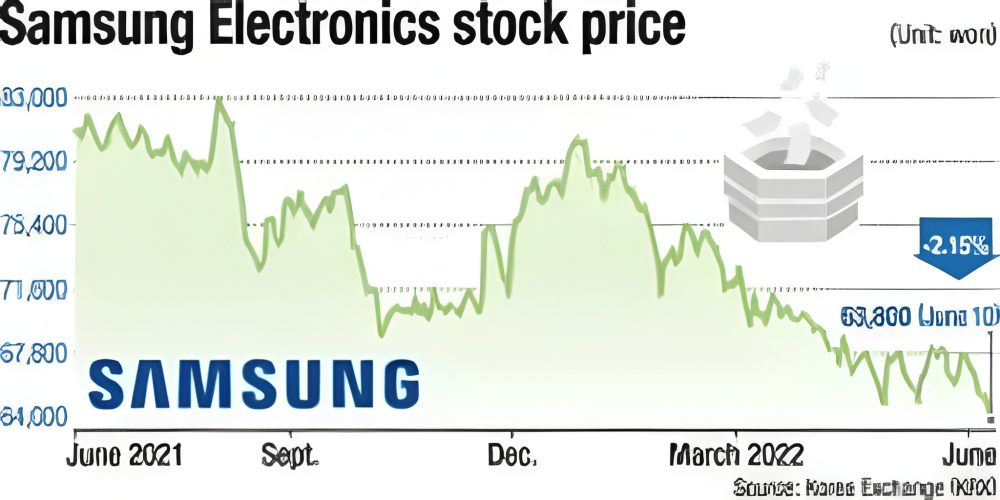
Looking at charts of Samsung stock, it often moves inside broad ranges instead of trending straight up or down for long periods. Support and resistance levels for Samsung stock are often tied to its 200-day moving average and the peaks from earlier chip cycles. Day traders in Seoul trade Samsung stock actively, sometimes using borrowed money, which can lead to sharp moves within a single day. For people who plan to hold for years, Samsung stock has delivered solid returns when bought during the low points of the memory cycle. Comparing Samsung stock to rivals like SK Hynix and Micron Technology, Samsung stock usually gets a small premium because of its diversification, but it can underperform pure memory plays during the most exciting parts of a chip boom because the phone and appliance divisions act as a drag.
Environmental, social, and governance issues are becoming more important for Samsung stock. The company has promised to use only renewable energy for all its operations by 2050. That pledge might raise costs, which could affect Samsung stock. On the social side, labor unions have not historically had much power at Samsung, but recent organizing efforts in South Korea could lead to higher wages, which would be a headwind for Samsung stock. Governance improvements, such as getting rid of the famous future strategy office that was involved in corruption scandals, have been welcomed by people who own Samsung stock. Still, legal risks around the Lee family, including enormous inheritance tax bills, remain a background concern that sometimes triggers selling in Samsung stock.
The competition facing Samsung stock comes from several directions. In displays, Chinese companies like BOE are getting better at making organic light-emitting diode screens, which threatens Samsung’s display division and could hurt Samsung stock over time. In home appliances, Chinese brands such as Haier and Hisense are growing their global presence, adding even more competition. To protect Samsung stock, the company is pushing into business-to-business areas like enterprise solid-state drives, automotive chips, and medical imaging equipment. These markets tend to be less cyclical, so they could make Samsung stock more stable over time. Also, Samsung is a leader in mini-LED and micro-LED television technology, which could give Samsung stock a boost as the high-end TV market evolves.
Broader economic trends also influence Samsung stock. Global growth, consumer confidence, and inventory levels at major electronics brands all correlate with how Samsung stock performs. A slowdown in China, which is the largest market for many electronics, directly hurts Samsung stock. Likewise, high inflation in the United States and Europe reduces the amount of money people can spend on new phones and televisions, which darkens the outlook for Samsung stock. Interest rates set by the Federal Reserve also affect Samsung stock through the way investors discount future earnings. When rates go up, technology stocks like Samsung stock often underperform compared to value sectors. However, because Samsung stock is already priced at a lower multiple than many US tech names, it has some protection against rate-driven sell-offs.
The dividend paid by Samsung stock is one of its attractions for certain investors. Unlike many technology companies that pay no dividend at all, Samsung stock sends cash back to shareholders twice a year. The typical dividend yield for Samsung stock falls between one and a half and two and a half percent, depending on the share price. That yield is lower than old-economy value stocks but higher than many famous US tech names. For people who want some current income along with potential price appreciation, Samsung stock offers a reasonable balance. Samsung has also reduced its share count through buybacks over the years, which increases earnings per share and supports Samsung stock over time. The management team’s decisions about how to allocate capital are therefore a key part of any analysis of Samsung stock.
Short selling is allowed on the Korea Exchange, though regulators have temporarily banned it during times of extreme stress. Short interest in Samsung stock tends to build up when investors expect earnings to come in below expectations, especially if market data shows memory chip prices falling. When the memory market suddenly turns around, short sellers of Samsung stock can get caught in rapid price increases and lose a lot of money. For that reason, Samsung stock is not a favorite for high-frequency short sellers, but it is sometimes used by hedge funds in pairs trades against other chip companies. The options market for Samsung stock is not as liquid as for US mega-cap stocks, but Korean derivatives offer some tools for hedging.
The future of Samsung stock will depend heavily on several new technologies. Artificial intelligence chips, self-driving cars, and the Internet of Things are all expected to drive demand for better memory and processing power. Samsung has been investing in high-bandwidth memory and automotive chips, which positions Samsung stock well for these trends. However, there are always risks with execution. Samsung has occasionally fallen behind competitors when moving to new manufacturing processes. How quickly the global economy recovers from inflation and supply chain problems will also affect Samsung stock. Analysts have a wide range of price targets for Samsung stock. Bullish ones talk about the AI opportunity. Bearish ones point to excess inventory of older chips.
Currency risk is something that international buyers of Samsung stock need to think about. Someone who buys Samsung stock on the Korea Exchange is exposed to changes in the value of the South Korean won versus the US dollar. If the won gets stronger against the dollar, that can reduce returns for foreign holders of Samsung stock. If the won gets weaker, returns get amplified. Hedging is possible but adds extra steps and costs. Some global investors prefer to gain exposure to Samsung stock through exchange-traded funds that hold Korean stocks, as those funds may have natural hedges built in. But the most direct way to bet on Samsung’s business remains Samsung stock itself.
Corporate actions like stock splits have had an impact on Samsung stock in the past. In 2018, Samsung did a 50-to-1 stock split to make Samsung stock more affordable for individual investors. That split increased trading volume and narrowed the gap between buying and selling prices, though it did not change the company’s true value. Since that split, Samsung stock has attracted more retail shareholders. The company has not announced another split, but if Samsung stock keeps rising on AI excitement, another split could be considered. For long-term charting, prices are adjusted to keep things consistent.
Samsung stock also plays a big role in many technology exchange-traded funds. A lot of emerging market and Asian technology funds put five to fifteen percent of their money into Samsung stock. As a result, when people put money into these funds passively, that automatically supports Samsung stock regardless of what is happening with the company specifically. This indexing effect reduces the impact of company-specific news on Samsung stock but also means that Samsung stock moves along with regional fund flows. Active investment managers who decide to hold more or less Samsung stock than the index weight are making a deliberate bet on the memory cycle and Samsung’s ability to execute.
People who have traded Samsung stock for a long time often watch the Korea Semiconductor Index as a leading clue. There is also a strong link between Samsung stock and the Philadelphia Semiconductor Index, though Samsung stock sometimes lags because of the time difference between New York and Seoul. Overnight trading in Samsung’s American Depositary Receipts can give hints about how Samsung stock will open the next day on the Korea Exchange. However, the American Depositary Receipts have lower liquidity, and true price discovery happens in the home market. Anyone serious about trading Samsung stock needs to keep an eye on the Seoul open.
To wrap things up, Samsung stock offers a mix of cyclical chip exposure, stable consumer electronics revenue, and slowly improving corporate behavior. We have looked at keyword Samsung stock through the lenses of memory pricing, foundry competition, political risks, and cash return policies. Samsung stock is not a short-term speculative play like some money-losing technology companies. But it has a long history of rewarding patient people who buy at the right point in the chip cycle. The challenges for Samsung stock today include weak demand for personal computers and phones, but new AI applications are a strong positive factor. By being careful with how much factory capacity it builds and by giving cash back to shareholders, Samsung management can increase the real value of Samsung stock. In the end, Samsung stock remains a core holding for many technology investors, representing the rise of Asian hardware companies in a world that runs on digital devices.
Short FAQs on Samsung Stock
Q1: Where is Samsung stock listed and what is its main ticker?
Samsung Electronics common shares trade on the Korea Exchange with the ticker 005930.KS. There are also preferred shares under 005935.KS. Over-the-counter American Depositary Receipts for Samsung stock trade as SSNLF.
Q2: Why does Samsung stock go up and down with memory chip prices?
A large part of Samsung’s operating profit comes from DRAM and NAND memory chips. When chip prices go up because of strong demand, Samsung stock tends to rise. When chip prices fall, profits shrink and Samsung stock usually drops.
Q3: Does Samsung stock pay a dividend?
Yes, Samsung stock pays dividends twice per year. The amount changes based on cash flow and decisions by the board. Historically, Samsung stock yields between one and a half and two and a half percent.
Q4: Is Samsung stock a value stock or a growth stock?
It has traits of both. On the value side, Samsung stock has a low price-to-earnings ratio compared to US tech giants and pays a dividend. On the growth side, the AI chip and foundry businesses offer expansion potential. Most analysts call Samsung stock a cyclical value stock.
Q5: What are the main risks to owning Samsung stock?
The biggest risks include a long downturn in memory chip demand, trade tensions between the United States and China, a stronger South Korean won against the dollar, and tougher competition from Chinese companies in phones and displays.
Q6: How can someone from outside South Korea buy Samsung stock?
International investors can buy Samsung stock directly through a broker that has access to the Korea Exchange. Another option is to buy over-the-counter American Depositary Receipts. Alternatively, they can invest in South Korea-focused exchange-traded funds that hold Samsung stock.
Q7: How often does Samsung report earnings, and when?
Samsung reports earnings four times per year. Reports usually come out in late April, late July, late October, and late January. Each report breaks down performance for semiconductors, displays, mobile devices, and home appliances, and each of those segments affects Samsung stock.
Q8: Has Samsung stock ever had a stock split?
Yes, Samsung stock had a 50-to-1 split in 2018. That split made Samsung stock more affordable for regular people and increased how often it traded. There has not been another split announced for Samsung stock as of now.
Q9: How does artificial intelligence affect Samsung stock?
AI is a positive force for Samsung stock because AI systems need high-bandwidth memory and advanced chip packaging. Samsung’s success in supplying those parts directly influences its earnings. Therefore, anyone watching Samsung stock pays close attention to AI server adoption.
Q10: Is Samsung stock a good choice for a long-term retirement portfolio?
Many financial advisors say Samsung stock can fit into a diversified retirement portfolio because it pays a dividend, has a strong global position, and ties into long-term technology trends. However, the memory chip cycle means Samsung stock can have down years that last a while, so it should not be the only stock in a retirement account.
Leave A Comment
0 Comment